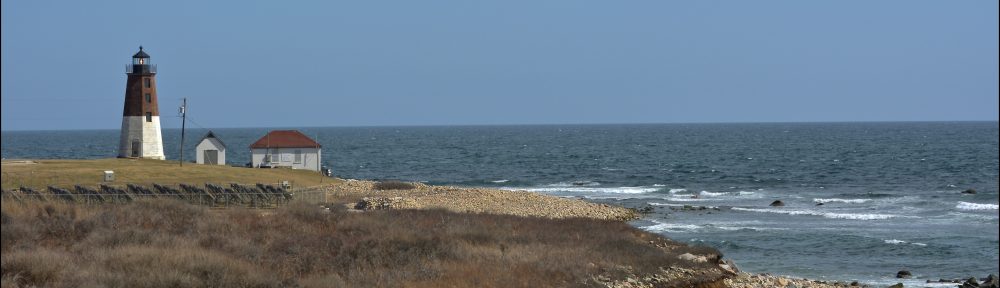
Images from the Highland Lighthouse (Cape Code Light) in Cape Cod, Massachusetts

The Highland Light (previously known as Cape Cod Light), an active lighthouse on the Cape Cod National Seashore in North Truro, Massachusetts, on the Outer Cape Code, is the oldest and tallest lighthouse on Cape Cod, and the 20th lighthouse built in the USA. It is owned by the National Park Service (a Cape Cod National Seashore property) and cared for by the Highland Museum and Lighthouse, Inc., while the United States Coast Guard operates the light itself. It is listed on the National Register of Historic Places as Highland Light Station.

In 1700, the town of Truro, Massachusetts, nine miles east of Race Point at the tip of Cape Cod, began its history under a different name—one it easily earned: “Dangerfield.” Even in calm weather, fishermen could suddenly find upon approaching land such a swell breaking that they dared not attempt to come ashore.

“I found that it would not do to speak of shipwrecks in the area, for almost every family had lost someone at sea,” Henry David Thoreau would later write about Truro in the December 1864 issue of Atlantic Monthly. “‘Who lives in that house?’ I inquired. ‘Three widows,’ was the reply. The stranger and the inhabitant view the shore with very different eyes. The former may have come to see and admire the ocean in a storm; but the latter looks on it as the scene where his nearest relatives were wrecked.”

Blindingly dense summer fogs lasting till midday that turn (in Thoreau’s words) “one’s beard into a wet napkin about the throat” provide conditions that to this day challenge even the most experienced mariner. The letter Reverend James Freemen wrote petitioning for a lighthouse near Truro stated that in 1794 more vessels were wrecked on the east shore of Truro than in all of Cape Cod.

On May 17th 1796, President George Washington signed the bill, along with $8,000 budget, authorizing a wood lighthouse to warn ships about the dangerous coastline between Cape Ann and Nantucket. It was the first light on Cape Cod, situated on ten acres on the Highlands of North Truro, was usually the first light seen when approaching the entrance of Massachusetts Bay from Europe.

The nation’s first eclipser was installed in the lantern room to differentiate Highland Light from others on the way to Boston, but delays in receiving it pushed the inaugural illumination back to January 15, 1798. With a focal plane of 180 feet above the sea, the light, with its array of lamps and reflectors, had the potential to be seen up to twenty-four miles, but the haze that often hung over the cape reduced the light’s visibility. Sperm whale oil was initially used in the light, but the fuel was later changed to lard.

In 1833, the wood structure was replaced by brick and in 1840 a new lantern and lighting apparatus was installed. In 1857 the lighthouse was declared dangerous and demolished, and for a total cost of $17,000, the current 66 foot brick tower was constructed, with a first order Fresnel lens from Paris. Along with the lighthouse, there was a keeper’s building and a generator shed, both of which can still be seen today.

In 1854, $25,000 was budgeted to rebuild Cape Cod Lighthouse on a proper site and to fit it with the “best approved illuminating apparatus to serve as substitution for three lights at Nauset Beach.”

Construction did not begin until 1856 on a new sixty-six-foot tower and a dwelling for the head keeper and a double-dwelling for his two assistants. The lighthouse was completed in October 1857, for $17,000, which included a new first-order Fresnel lens that produced a fixed white light. Before the addition of the first-order lens, the station had employed just one keeper. The sixty-nine winding steps leading to the lantern room could be quite tricky for man.
In 1873, $5,000 was allocated for the station to receive a first-class Daboll trumpet fog horn that gave blasts of eight seconds, with intervals between them of thirty seconds. A frame engine-house, measuring twelve feet by twenty-four feet, was built for the fog signal along with a fuel shed.

At the turn of the nineteenth century, duplicate four-horsepower oil engines with compressors replaced the old caloric engines, reducing the time needed to produce the first blast of the fog signal from forty-five to ten minutes. In 1929, an electrically operated air oscillator fog signal was installed at the station as mariners complained that the old reed horns could hardly be heard above the heavy surf crashing on the beach below the station. Power for operating the new signal was furnished by a direct-current generator, driven by a four-cycle, internal-combustion engine that ran on kerosene.

On June 6, 1900, Congress appropriated $15,000 for changing the light’s characteristic from fixed to flashing. The new Barbier, Benard & Turenne first-order Fresnel lens had four panels of 0.92 meter focal distance, revolved in mercury, and gave, every five seconds, flashes of about 192,000 candlepower nearly one-half second in duration. While the new lens was being installed, the light from a third-order lens was exhibited atop a temporary tower erected near the lighthouse. After the new light was exhibited on October 10, 1901, the temporary tower was sold at auction.

In 1946, the Fresnel lens was replaced with a Crouse-Hinds, double-drum, rotating DCB-36 aerobeacon, which was in turn replaced during the automation process in 1987 with a Crouse-Hinds DCB-224 rotating beacon. The Fresnel lens was mostly destroyed during its removal, but a piece is on display at the lighthouse.

By the 1960s, the assistant keeper’s double-dwelling and fog horn building had been removed, and Keeper Isaac Small’s original ten acres had shrunk to little more than two. In the early 1990s, erosion seriously threatened the light. While in 1806, the tower had stood 510 feet from the cliff, by 1989, that distance had shrunk to just 128 feet.

Highland Lighthouse attracted visitors even when it was staffed by resident keepers. In 1922, 7,300 people registered at the lighthouse. Highland Museum and Lighthouse, Inc. was formed in 1998 as a non-profit to partner with the National Park Service in running a gift shop in the keeper’s dwelling and in offering tours of the lighthouse. After fifteen years in this role, the non-profit lost its contract due to operational issues, and on January 1, 2014, Eastern National was awarded the contract for operating the lighthouse.
The present location of the lighthouse is not the original site as beach erosion had rendered the original location dangerous. The structure was moved 450 feet (140 m) to the west from the cliff’s edge. The move was undertaken in 1996 at a cost of $1.5 million. The 430-ton structure was successfully moved intact on I-beams greased with Ivory soap.

Formerly a location associated with notable danger, the lighthouse presently is surrounded by an oceanfront golf course, the Highland Golf Course. After an errant golf ball broke a window, they were replaced with unbreakable material. The lighthouse grounds are open year-round on Highland Light Road in Truro, with tours and the museum available by the National Park Service during the summer months.

Highland Light Station is located on Highland Rd. in North Truro. Traveling north on Rte. 6, take the “Cape Cod/Highland Rd.” exit; turn right onto Highland Rd. and follow to the Highland Lighthouse area. Highland Light Station is situated on grounds owned by the National Park Service as part of the Cape Cod National Seashore and is managed by the Truro Historical Society. The grounds are open all year and the lighthouse is open May-October. A trip to the light station allows the visitor to enjoy the Interpretive Center, watch a 10-minute video and climb the lighthouse tower for a small fee. For further information, visit the Truro Historical Society‘s website or call 508-487-1121.

Sources:

Previously posted pictures by Karatzas Images of Lighthouse ‘Highland Light’ can be seen here.

Cape Cod (Highland), MA, LighhouseFriends.com

Maritime History of Massachusetts 
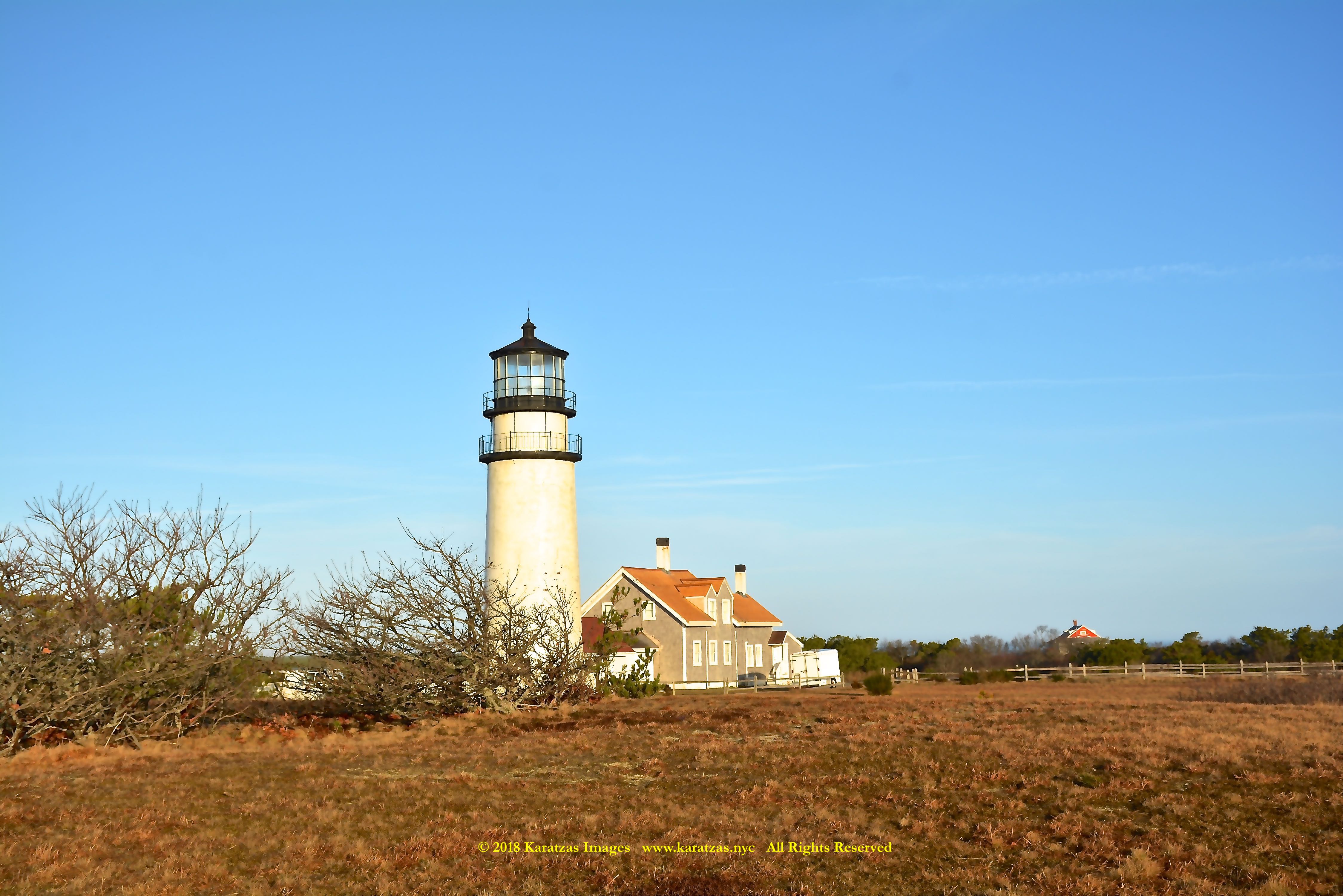
The original (wooden) lighthouse at Highlands, Cape Cod was authorized by America’s first President, George Washington. Current (brick-built) lighthouse had to be moved westward inland by 450 ft due to beach erosion. Cape Cod Light (Highland Light) is a majestic sight under any circumstances. Image credit: Karatzas Images
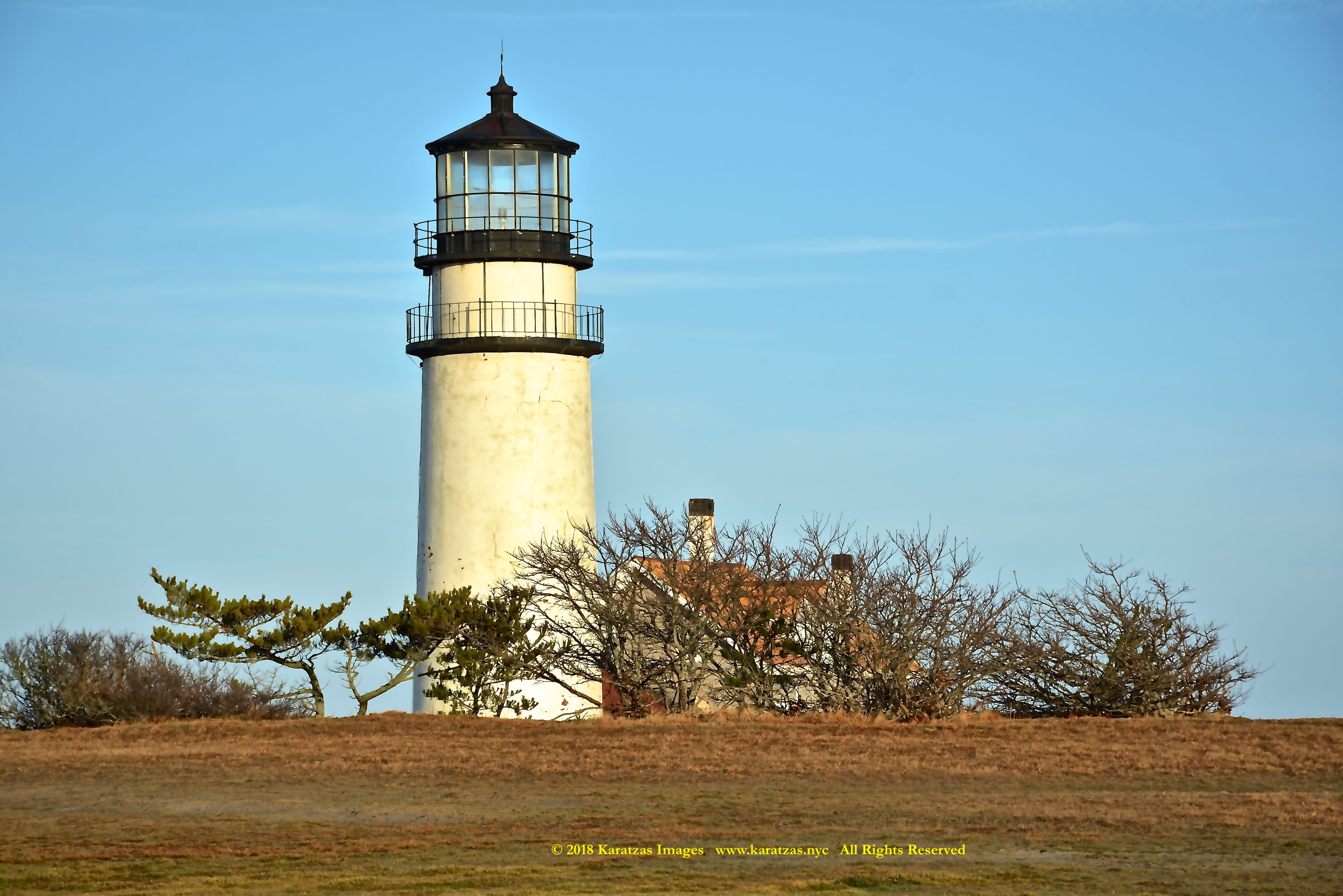
The original (wooden) lighthouse at Highlands, Cape Cod was authorized by America’s first President, George Washington. Current (brick-built) lighthouse had to be moved westward inland by 450 ft due to beach erosion. Cape Cod Light (Highland Light) is a majestic sight under any circumstances. Image credit: Karatzas Images

The original (wooden) lighthouse at Highlands, Cape Cod was authorized by America’s first President, George Washington. Current (brick-built) lighthouse had to be moved westward inland by 450 ft due to beach erosion. Cape Cod Light (Highland Light) is a majestic sight under any circumstances. Image credit: Karatzas Images

The original (wooden) lighthouse at Highlands, Cape Cod was authorized by America’s first President, George Washington. Current (brick-built) lighthouse had to be moved westward inland by 450 ft due to beach erosion. Cape Cod Light (Highland Light) is a majestic sight under any circumstances. Image credit: Karatzas Images

The original (wooden) lighthouse at Highlands, Cape Cod was authorized by America’s first President, George Washington. Current (brick-built) lighthouse had to be moved westward inland by 450 ft due to beach erosion. Cape Cod Light (Highland Light) is a majestic sight under any circumstances. Image credit: Karatzas Images
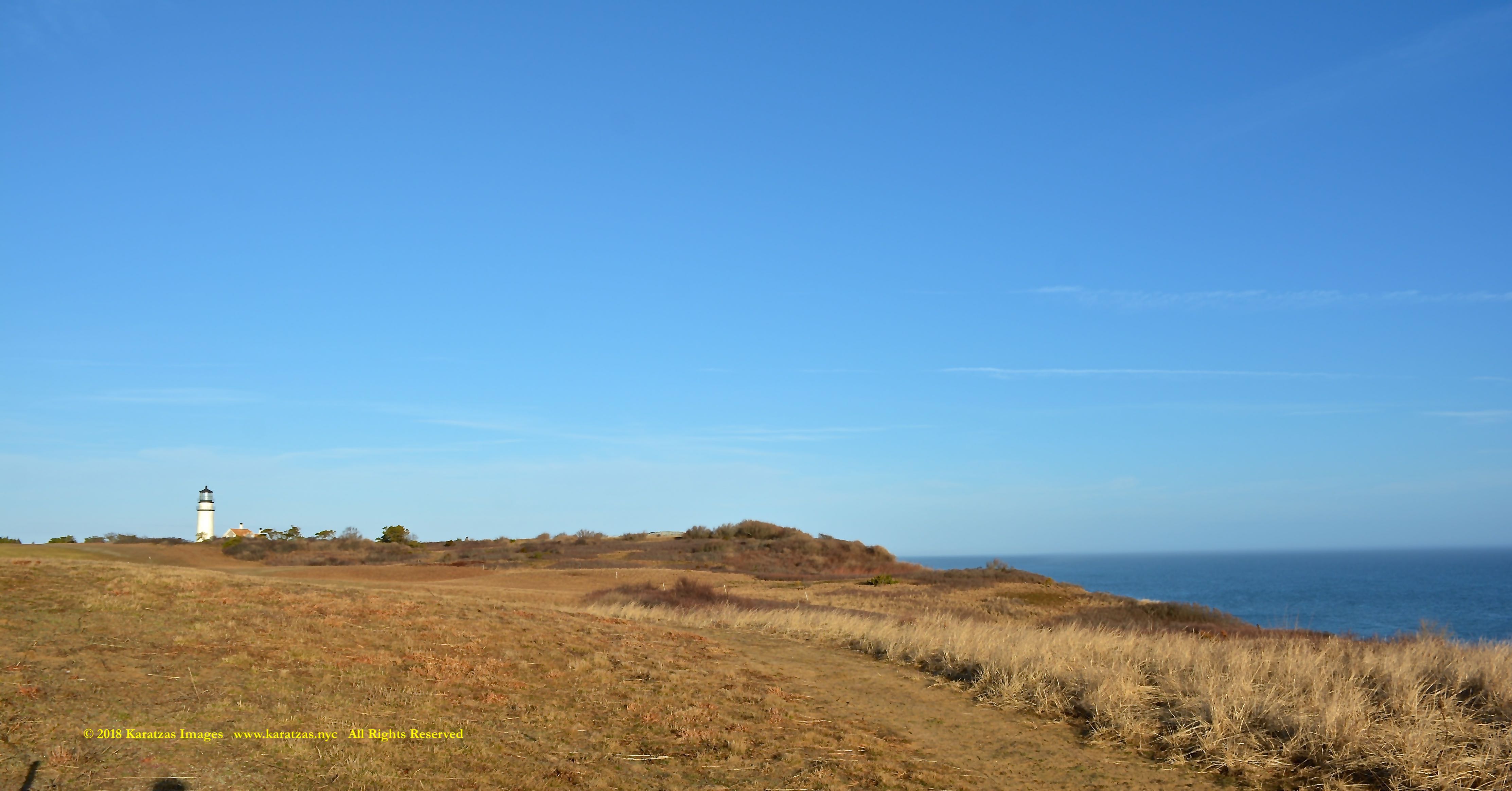
The original (wooden) lighthouse at Highlands, Cape Cod was authorized by America’s first President, George Washington. Current (brick-built) lighthouse had to be moved westward inland by 450 ft due to beach erosion. Cape Cod Light (Highland Light) is a majestic sight under any circumstances. Image credit: Karatzas Images

Current (brick-built) lighthouse had to be moved westward inland by 450 ft due to beach erosion and presently is located in the Highland Gulf Course. Cape Cod Light (Highland Light) is a majestic sight under any circumstances. Image credit: Karatzas Images
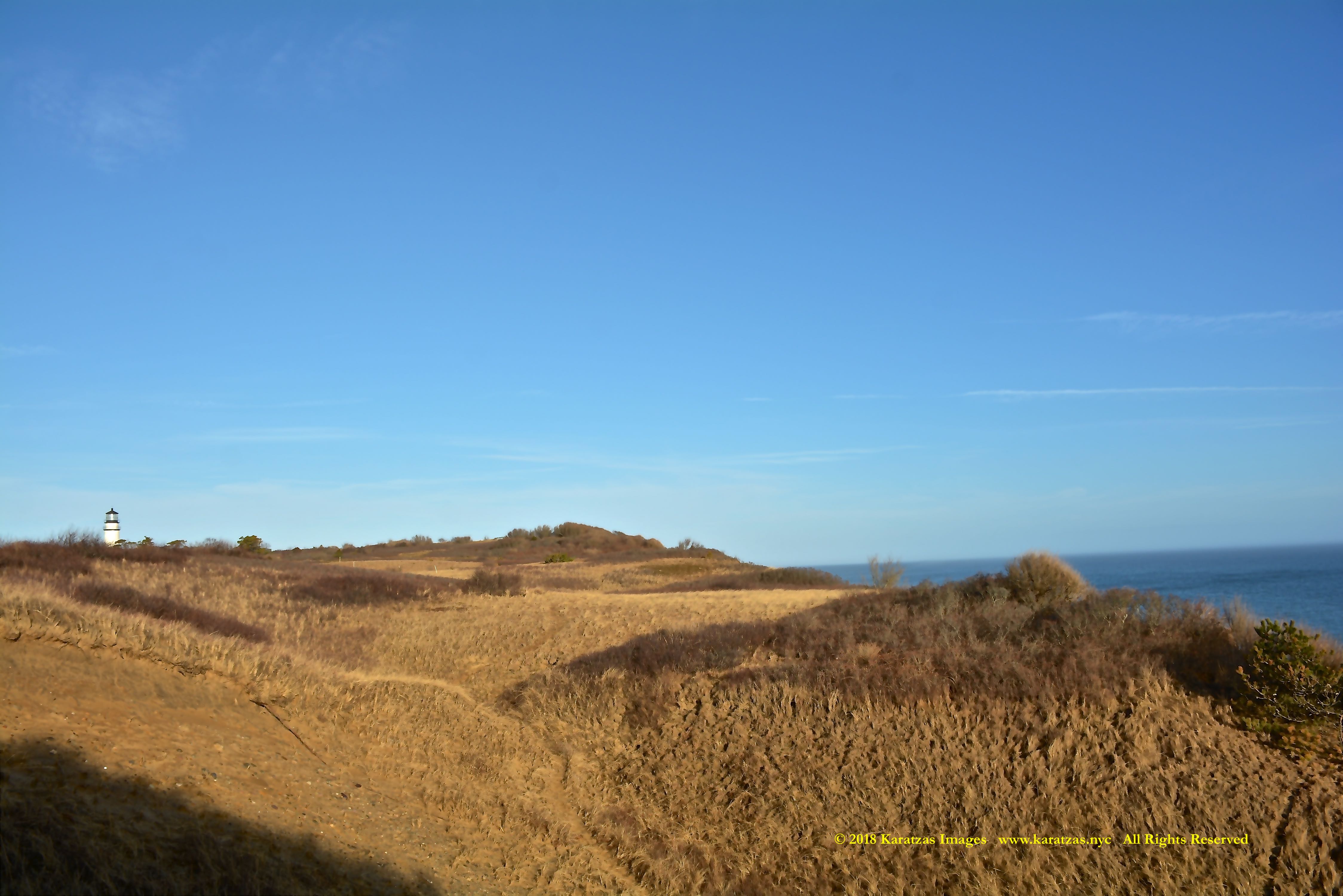
Current (brick-built) lighthouse had to be moved westward inland by 450 ft due to beach erosion and presently is located in the Highland Gulf Course. Cape Cod Light (Highland Light) is a majestic sight under any circumstances. Image credit: Karatzas Images

The Cape Cod National Seashore facing the Atlantic Ocean; beach erosion is visible. Image credit: Karatzas Images

Current (brick-built) lighthouse had to be moved westward inland by 450 ft due to beach erosion and presently is located in the Highland Gulf Course. Cape Cod Light (Highland Light) is a majestic sight under any circumstances. Image credit: Karatzas Images
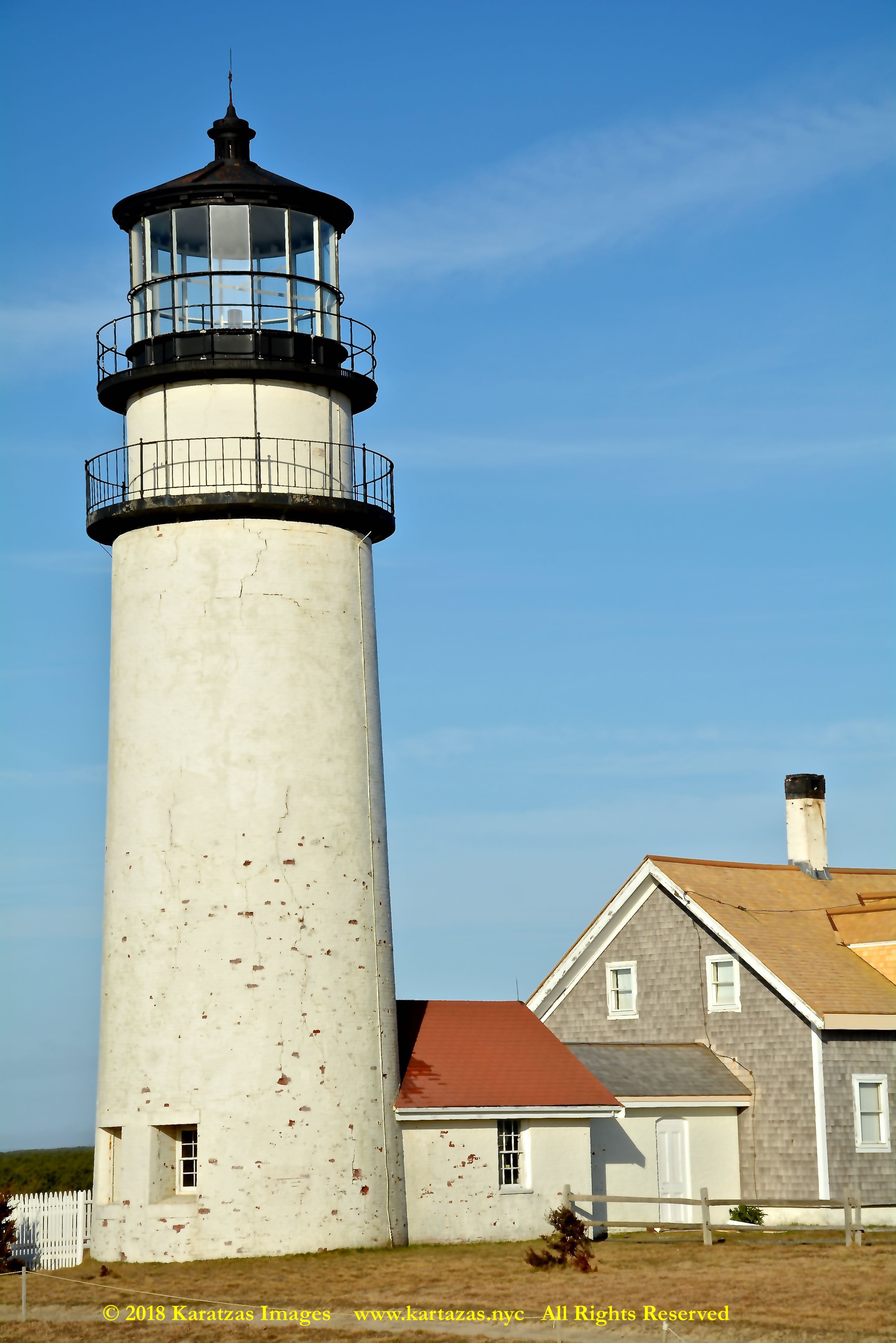
The original (wooden) lighthouse at Highlands, Cape Cod was authorized by America’s first President, George Washington. Current (brick-built) lighthouse had to be moved westward inland by 450 ft due to beach erosion. Cape Cod Light (Highland Light) is a majestic sight under any circumstances. Image credit: Karatzas Images

Current (brick-built) lighthouse had to be moved westward inland by 450 ft due to beach erosion and presently is located in the Highland Gulf Course. Cape Cod Light (Highland Light) is a majestic sight under any circumstances. Image credit: Karatzas Images
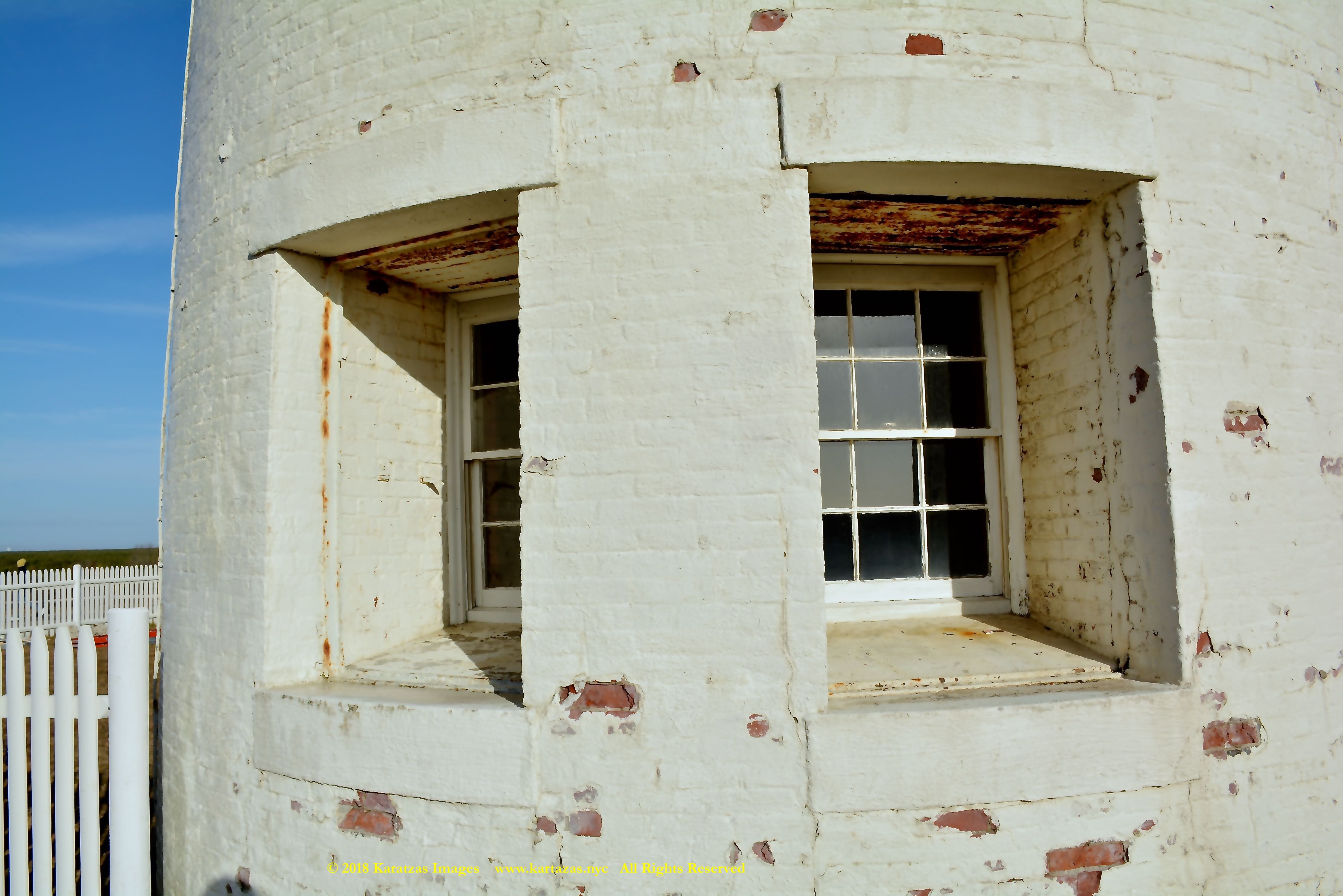
The original (wooden) lighthouse at Highlands, Cape Cod was authorized by America’s first President, George Washington. Current (brick-built) lighthouse had to be moved westward inland by 450 ft due to beach erosion. Cape Cod Light (Highland Light) is a majestic sight under any circumstances. Image credit: Karatzas Images

Current (brick-built) lighthouse had to be moved westward inland by 450 ft due to beach erosion and presently is located in the Highland Gulf Course. Cape Cod Light (Highland Light) is a majestic sight under any circumstances. Image credit: Karatzas Images
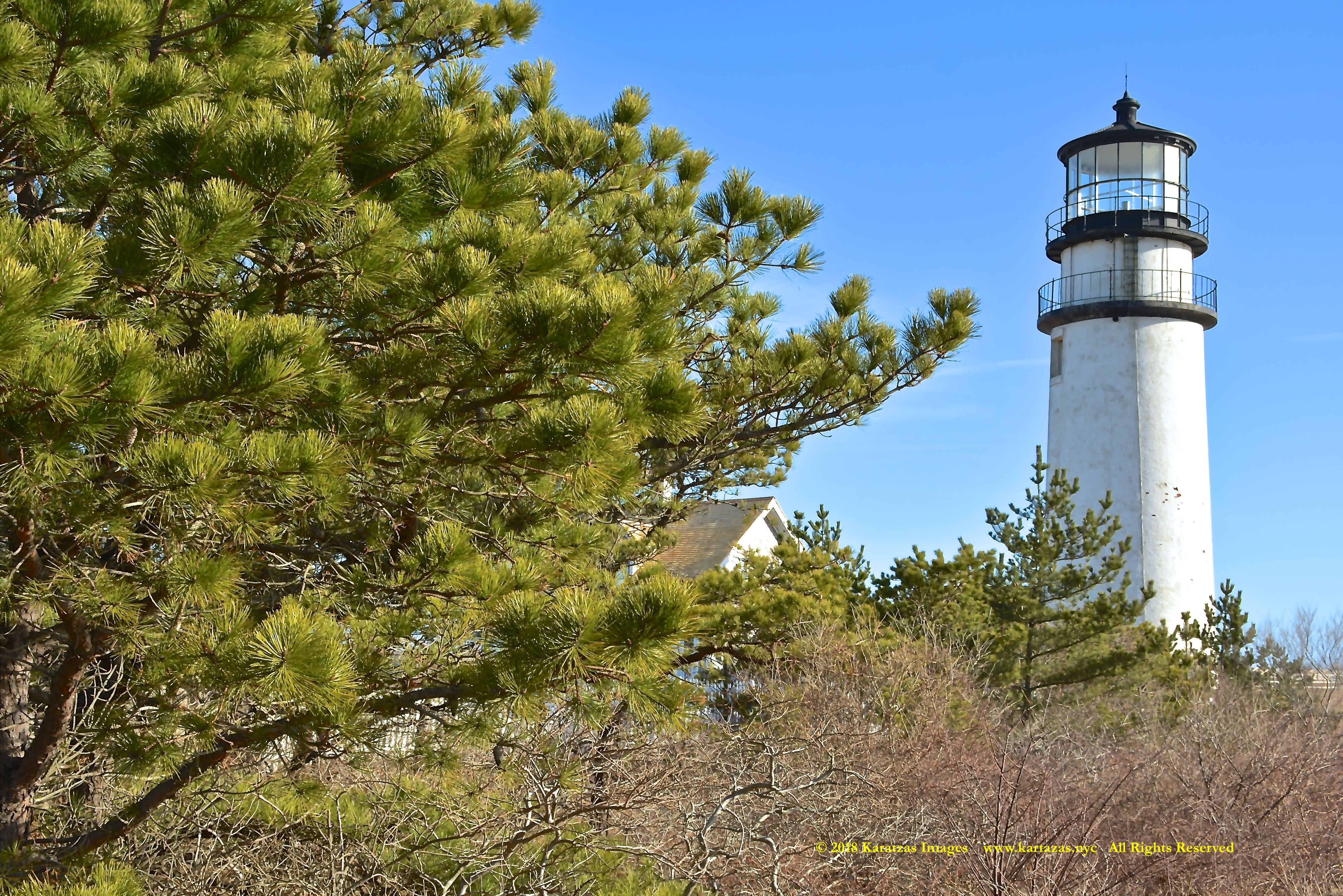
Current (brick-built) lighthouse had to be moved westward inland by 450 ft due to beach erosion and presently is located in the Highland Gulf Course. Cape Cod Light (Highland Light) is a majestic sight under any circumstances. Image credit: Karatzas Images
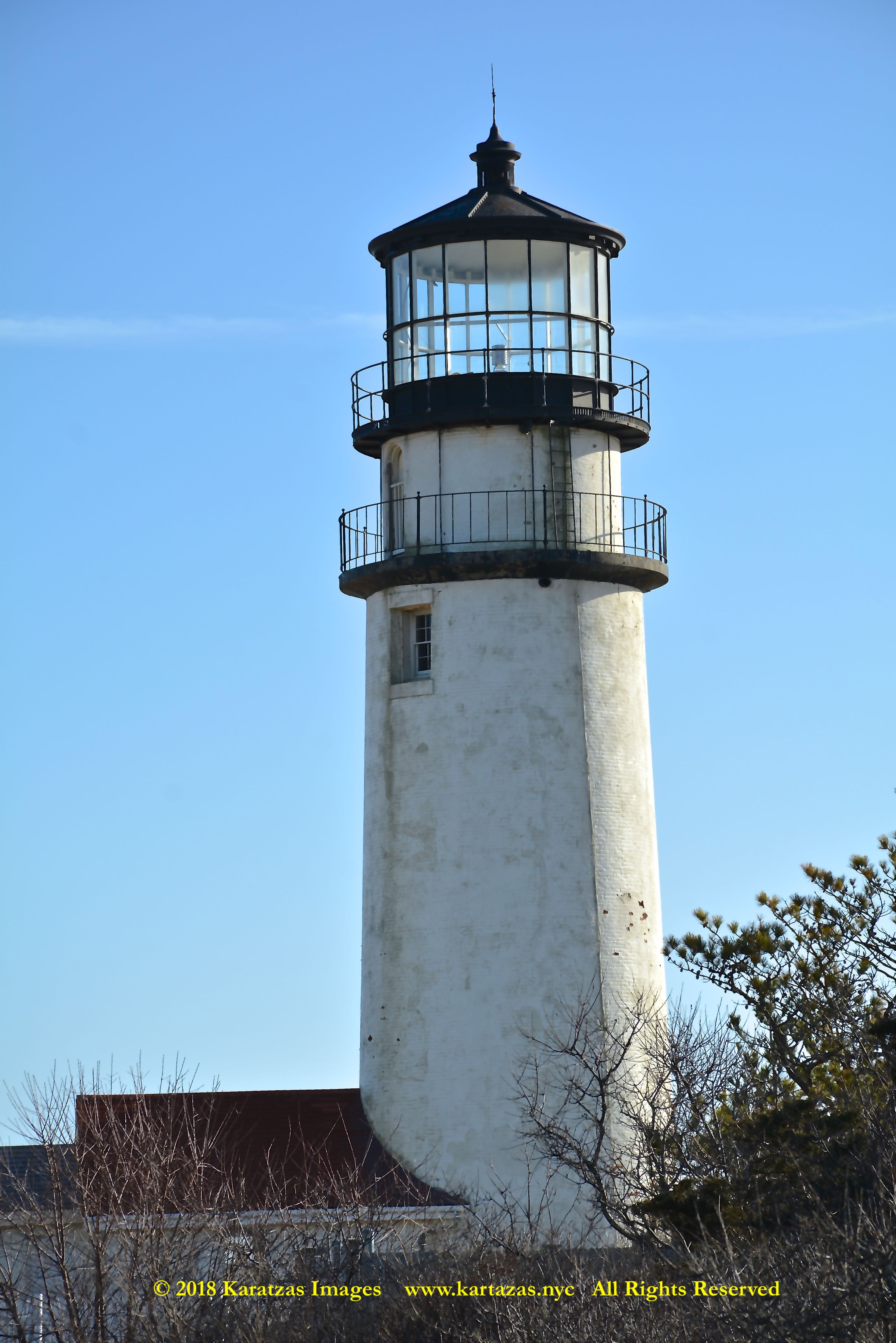
The original (wooden) lighthouse at Highlands, Cape Cod was authorized by America’s first President, George Washington. Current (brick-built) lighthouse had to be moved westward inland by 450 ft due to beach erosion. Cape Cod Light (Highland Light) is a majestic sight under any circumstances. Image credit: Karatzas Images

© 2013 – present Basil M Karatzas & Karatzas Images. All Rights Reserved.

IMPORTANT DISCLAIMERS: The purpose of this blog is for entertainment and information purposes. Vessel description(s), if any, is/are provided in good faith and believed to be correct and accurate but no assurances, warranties or representations are made herewith. Any vessel description(s) is/are provided for entertainment purposes only. We assume no responsibility whatsoever for any errors / omissions in vessel description.

Access to this blog signifies the reader’s irrevocable acceptance of this disclaimer. No part of this blog can be reproduced by any means and under any circumstances, whatsoever, in whole or in part, without proper attribution or the consent of the copyright and trademark holders of this website. To purchase rights or merchandise of high resolutions images and art presented here, please visit www.karatzas.nyc or email < info [at] BMKaratzas.com >. Thank you for the consideration.

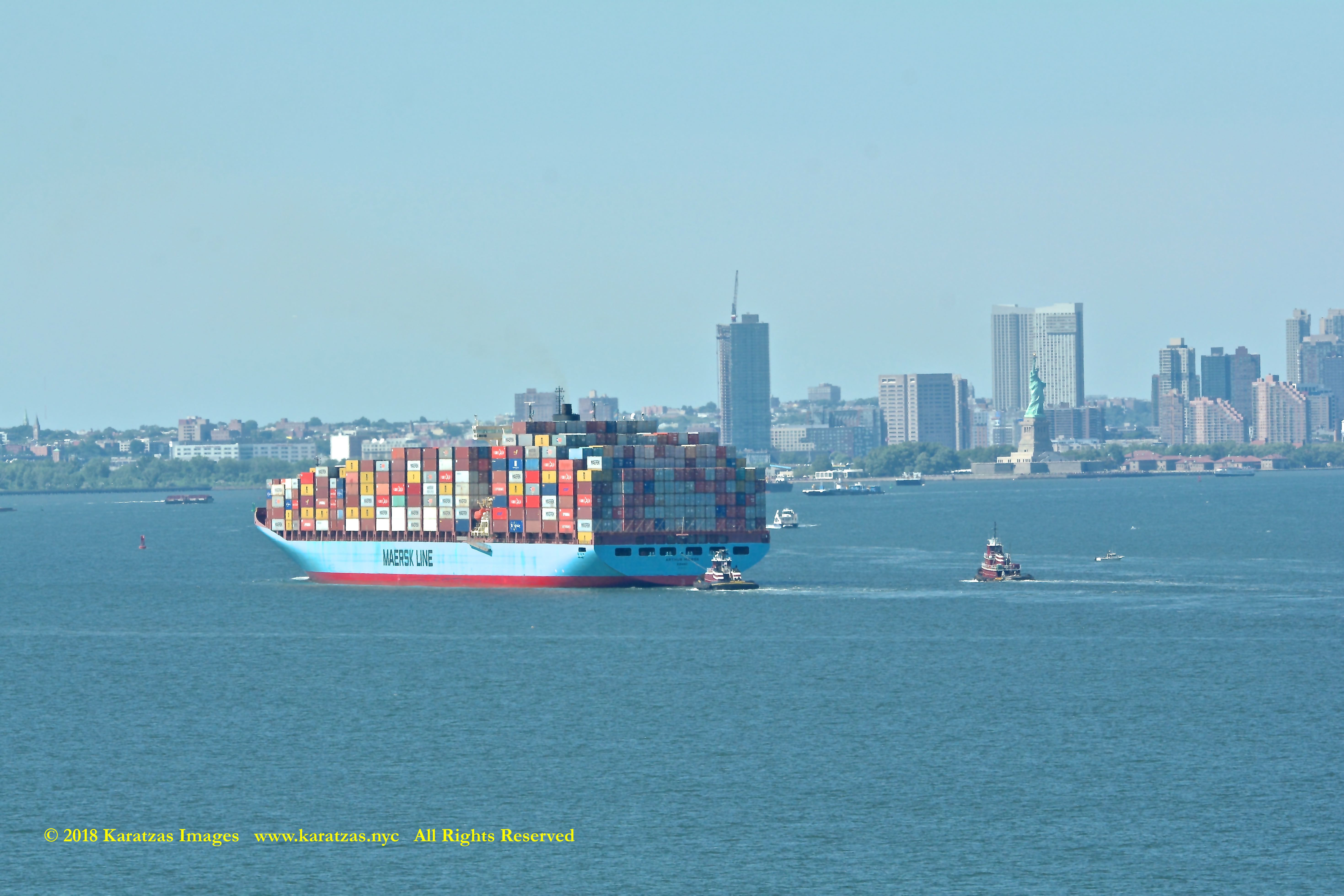
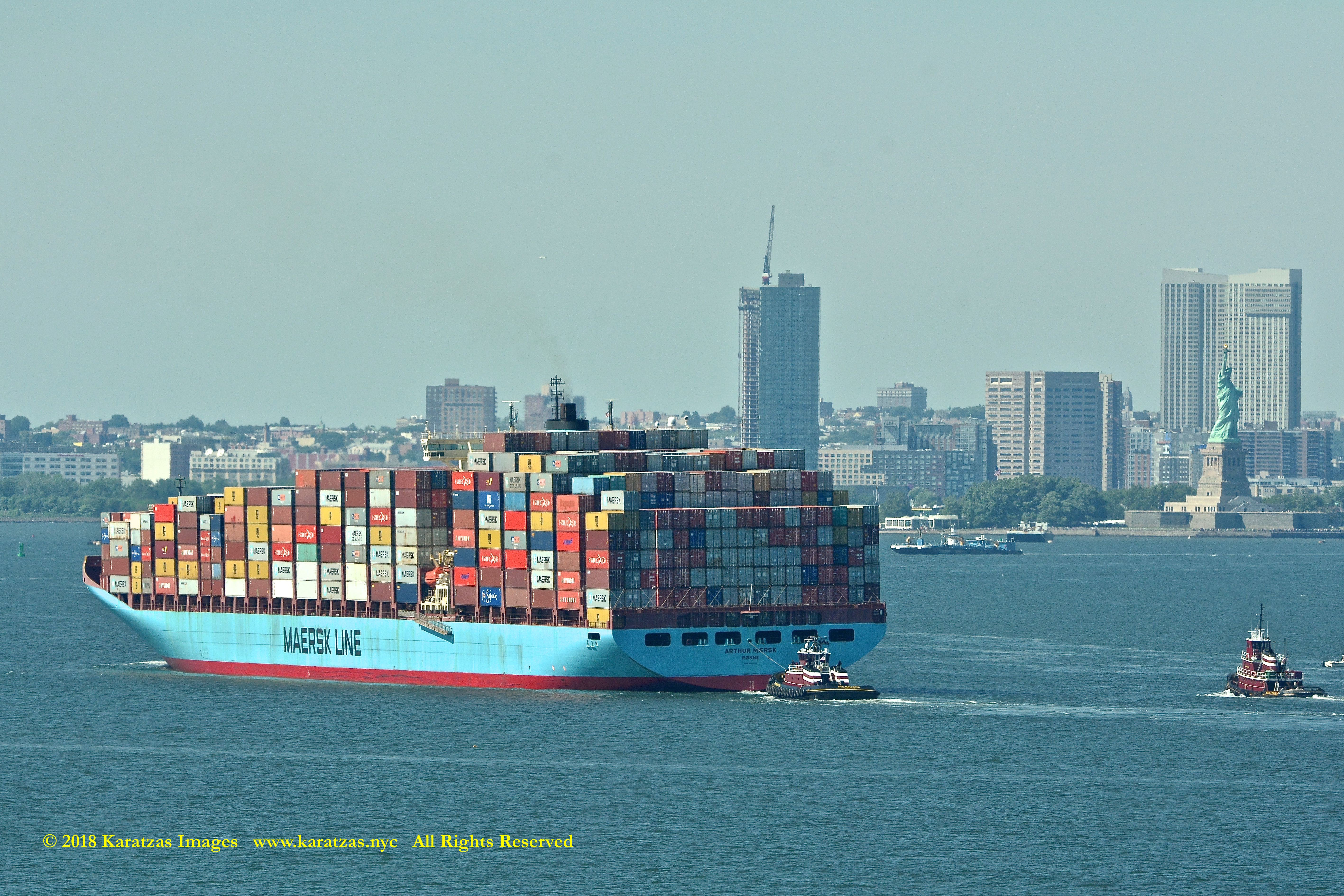
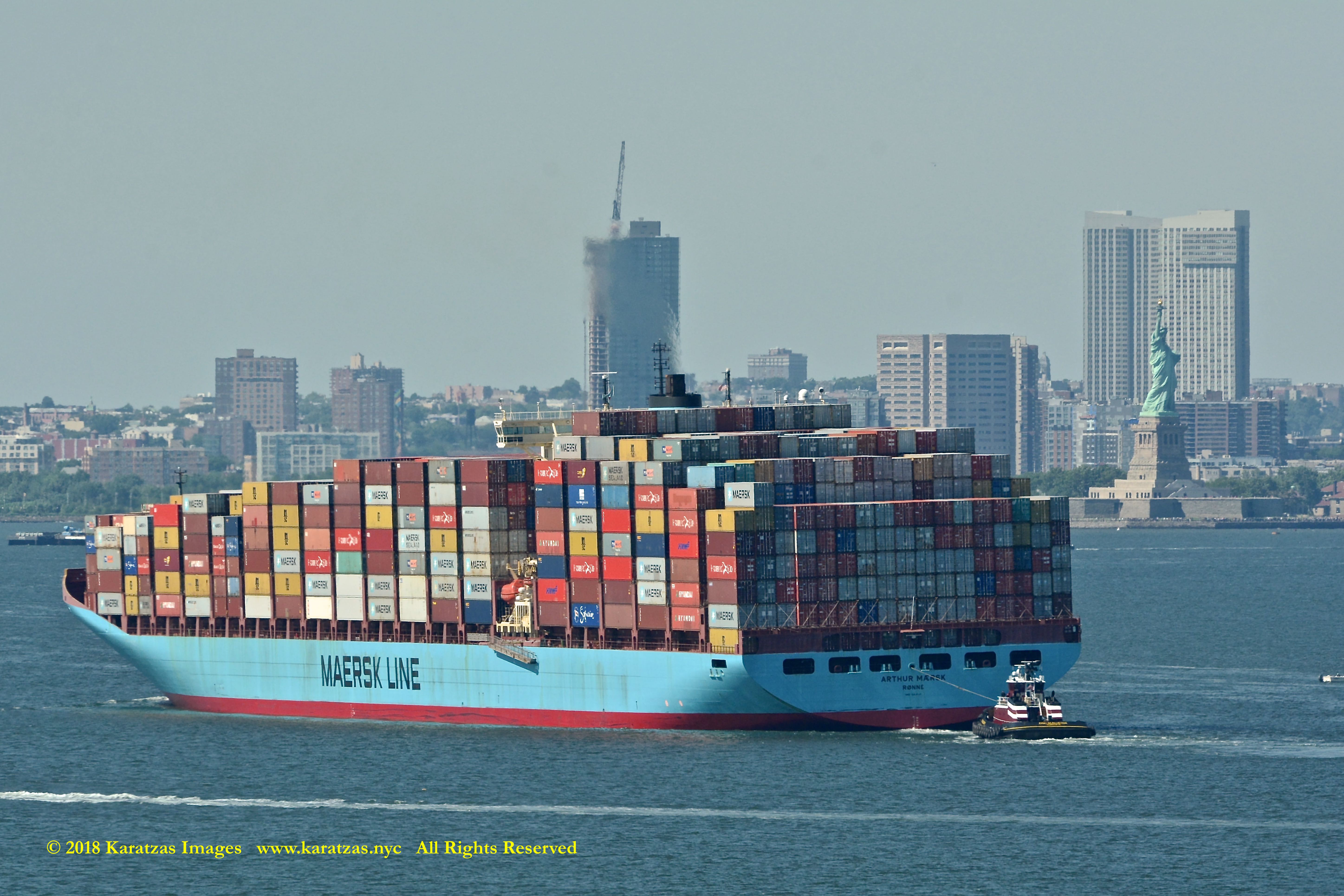
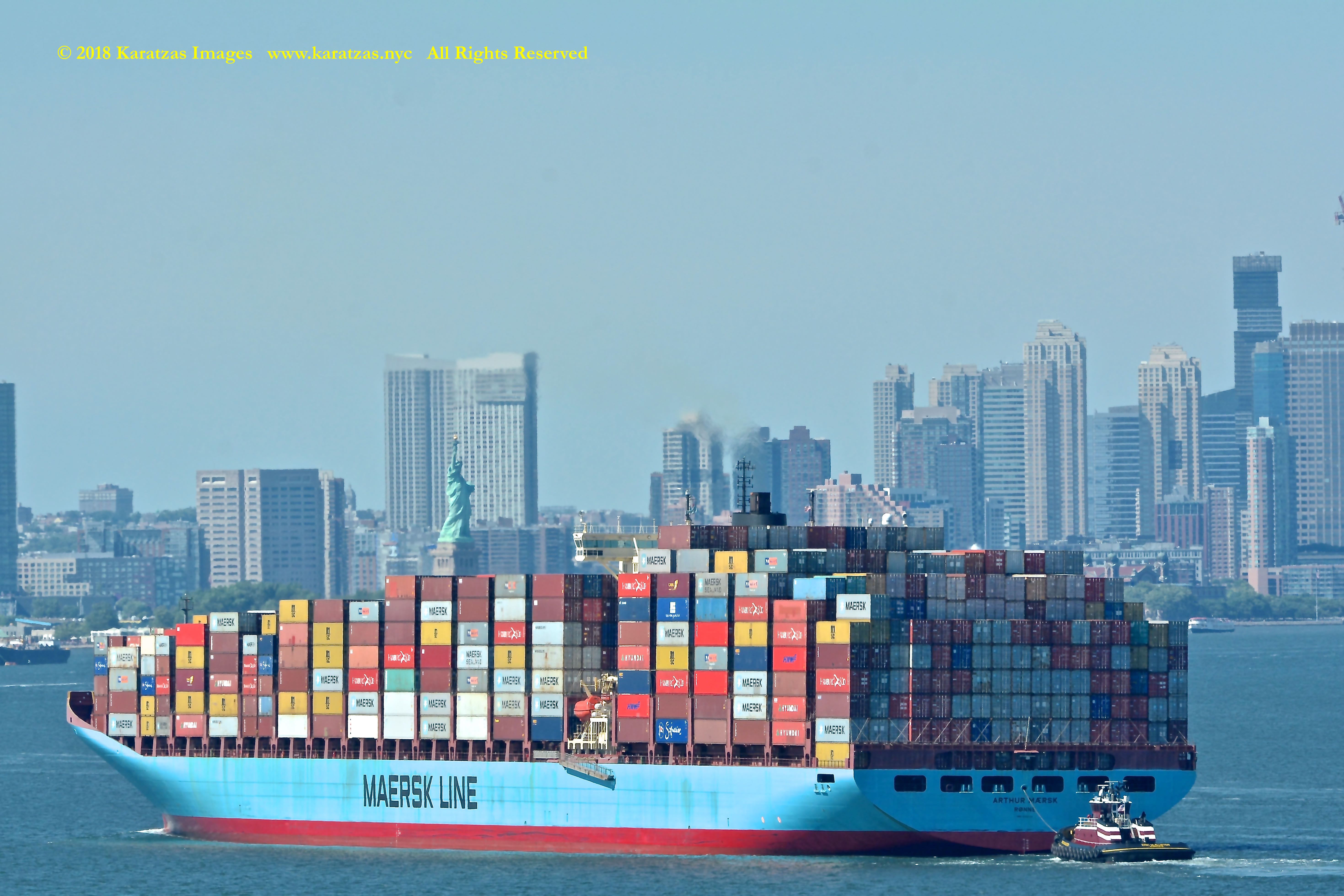
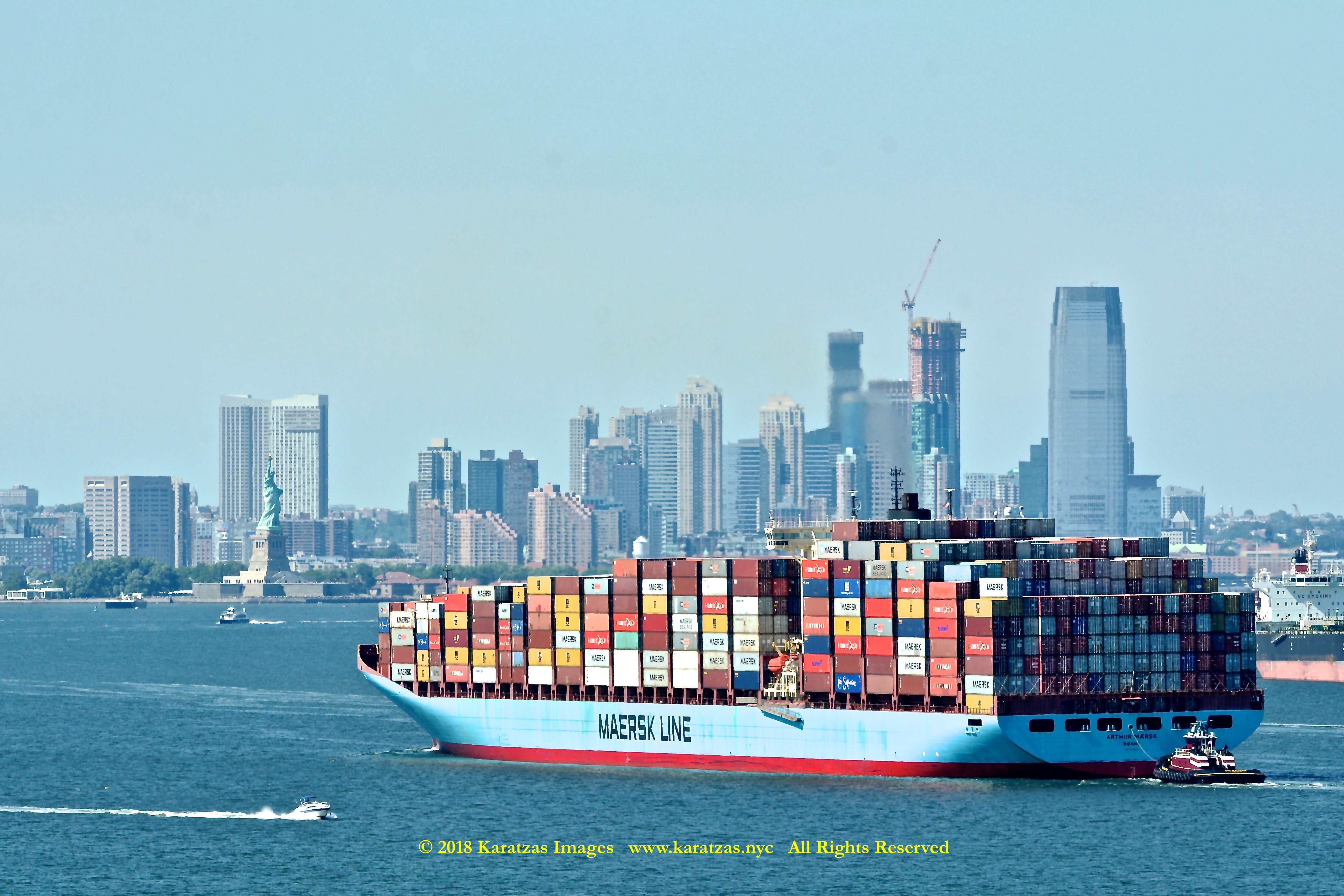
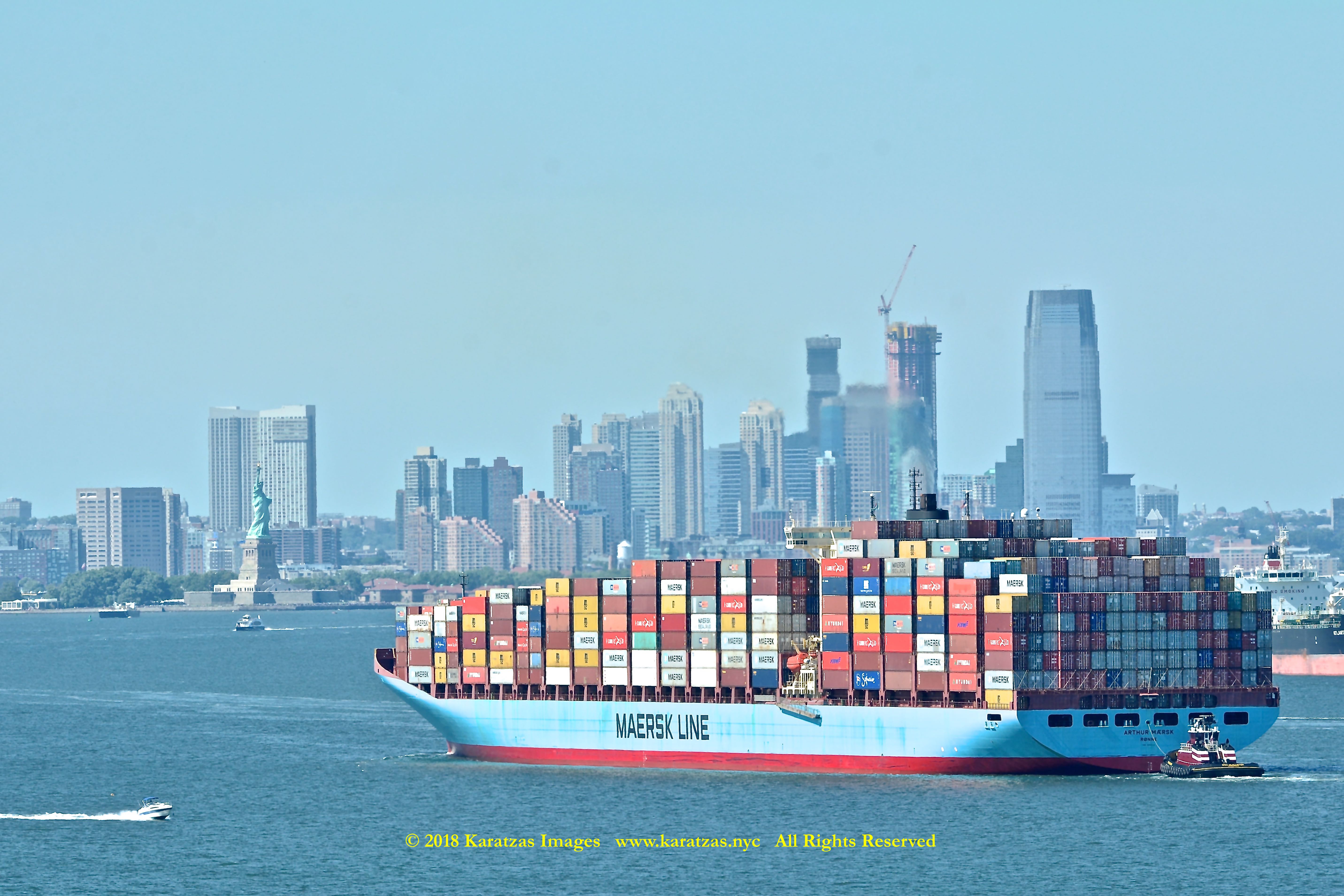
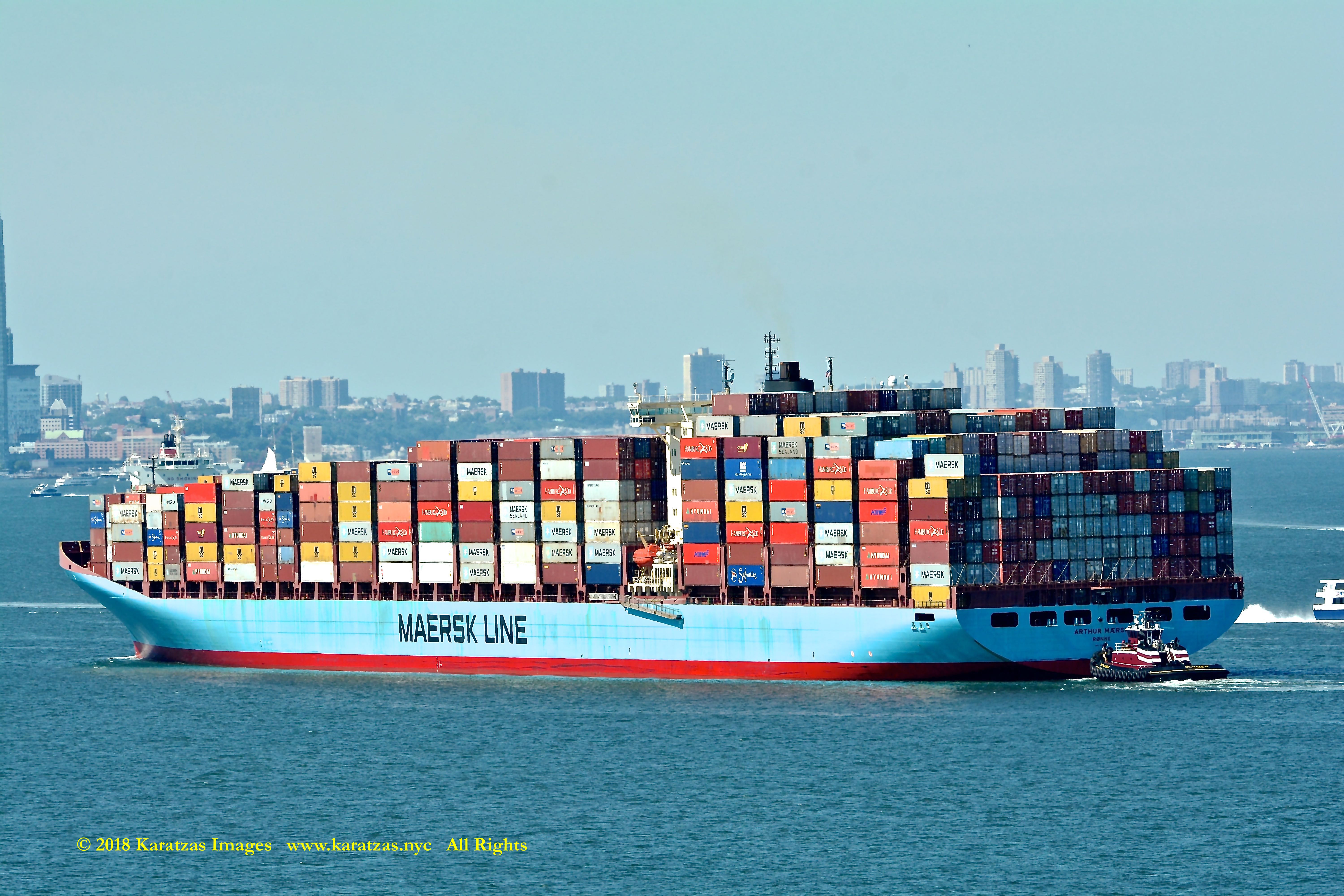
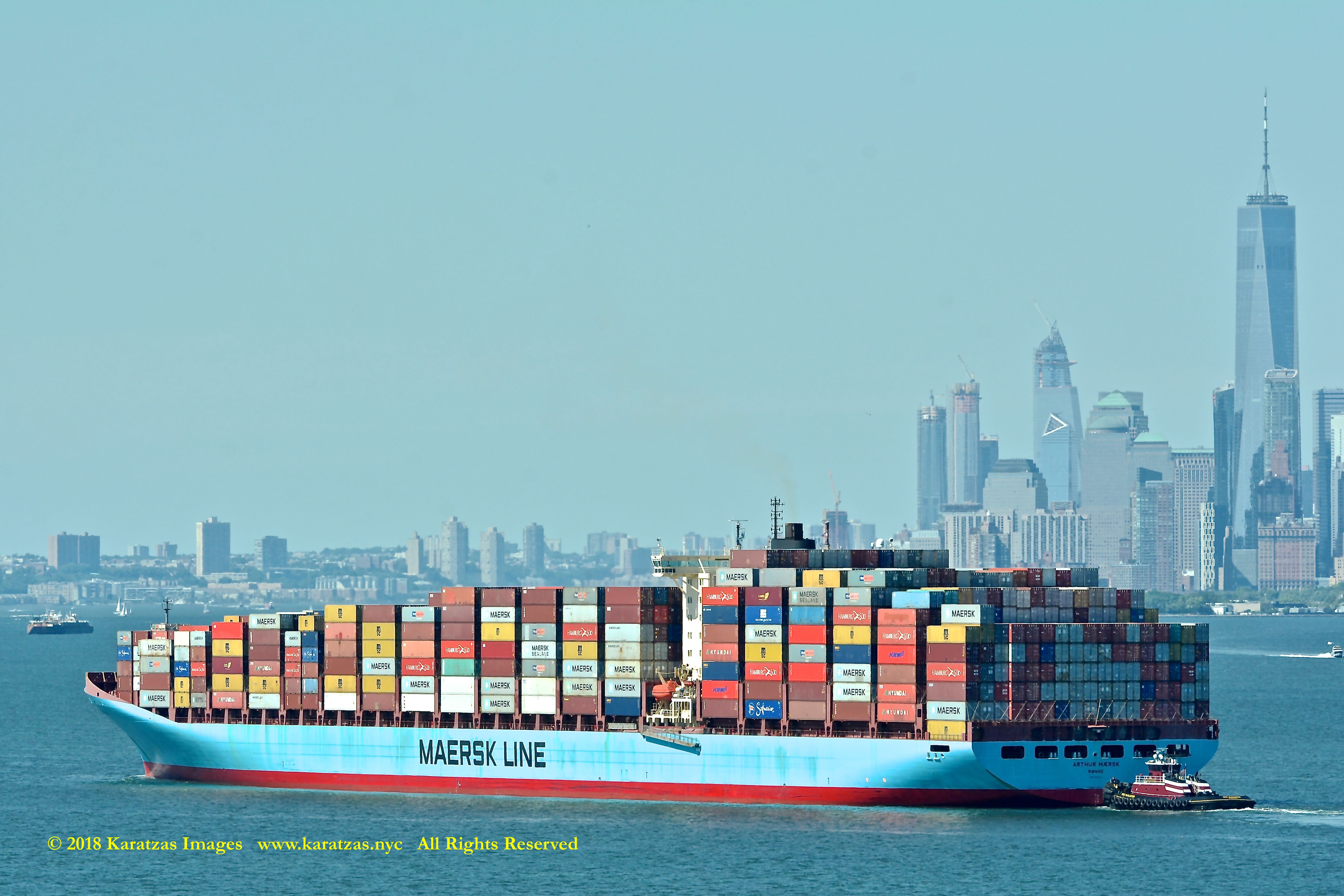
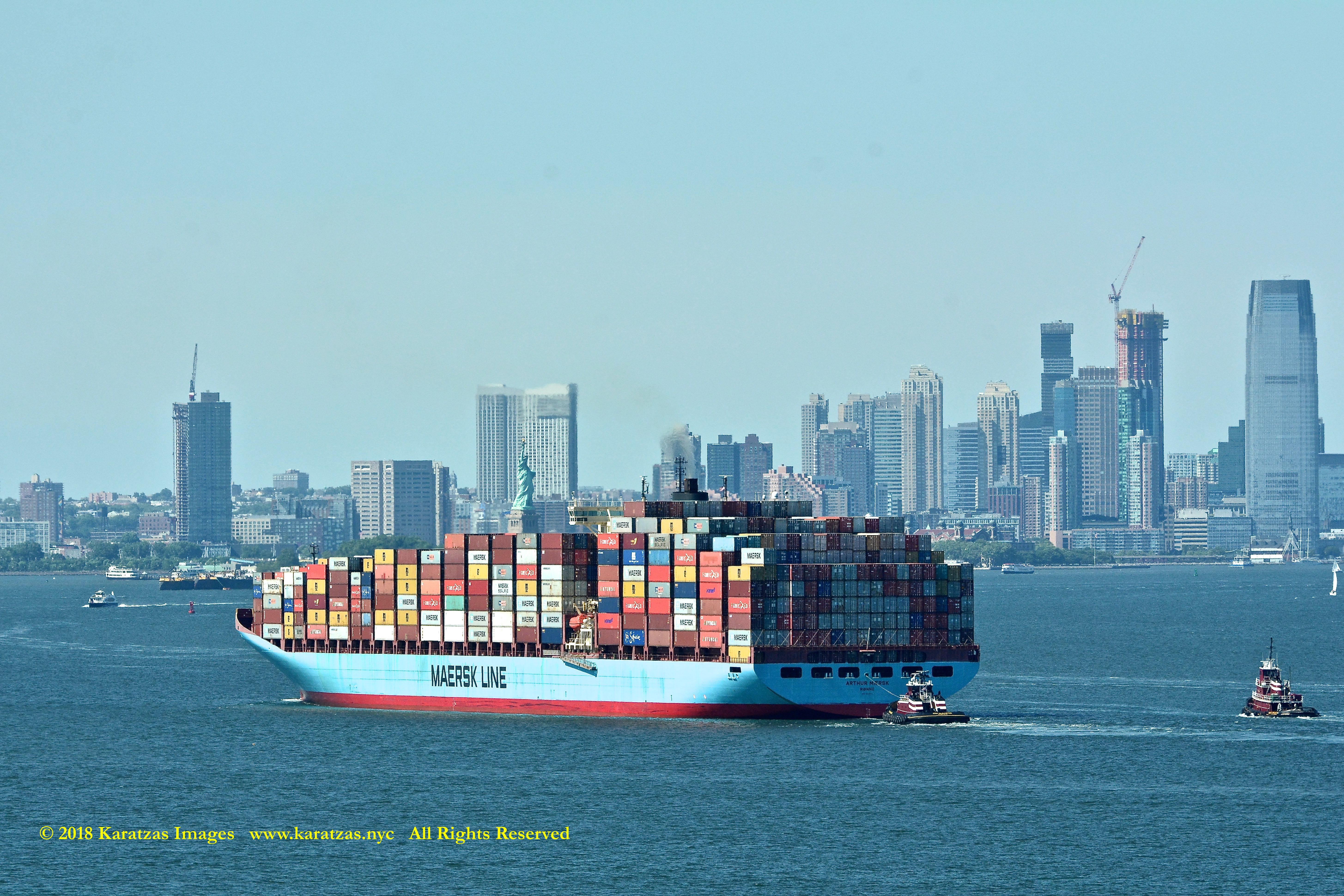
Images of MV ‘Arthur Maersk’ with the Statue of Liberty, in New York

Images of Containership MV ‘Arthur Maersk’ with the Statue of Liberty
Neo-panamax, Fully Cellular Containership 8,270 TEU, built in 2003

VESSEL IDENTIFICATION & DESCRIPTION: Call Sign OXJH2, IMO Number 9260445. Built at Odense Lindo delivered in 2003, Danish Int’l Register Flagged, ABS Classed, Length Overall of 352.60 m., Length Between Perpendiculars of 336.40 m., Draught of 15.00 m., Moulded Depth of 24.10 m. Beam of 42.80 m., Gross Tonnage of 93,496, Tonnage of 83,462 Suez Canal Net, 49,741 International Net and 107,278 Dwt (long). Sulzer Engine, Speed of 25.00 kts at 250.00 tonnes per day, IFO 380, Horsepower of 77,717, Bunker Capacity of 11,147 IFO 380.

VESSEL’S OWNERS / MANAGERS: Maersk Line A/S, Copenhagen, Denmark. Maersk Line A/S is a group company of A.P. Moller – Maersk A/S. Group Company: A.P. Moller – Maersk A/S, Denmark.

CARGO HANDLING DETAILS: Teu Capacities of 8,270 Total and 1,672 Reefer. 836 Reefer Plugs. Lifting Equipment: No Cargo Gear / Gearless.

MAIN ENGINE & PROPULSION:
MAIN ENGINE:  1 x Diesel – Sulzer 10RTA96C-B – 2-stroke 10-cyl. 960mm x2500mm bore/stroke 57,200mkW total at 102rpm.

AUXILIARY: 3 x Aux. Diesel Gen – 4-stroke 10,365mkW total driving 3 x AC generator(s). 1 x Shaft Generator (PTO) – Siemens Energy at 6,000ekW total.

PROPULSOR: 1 x FP Propeller (Aft Centre) (mechanical) (Ni-Al Bronze), MMG, 102rpm.

OTHER ENGINE EQUIPMENT: 1 x Screw Shaft.

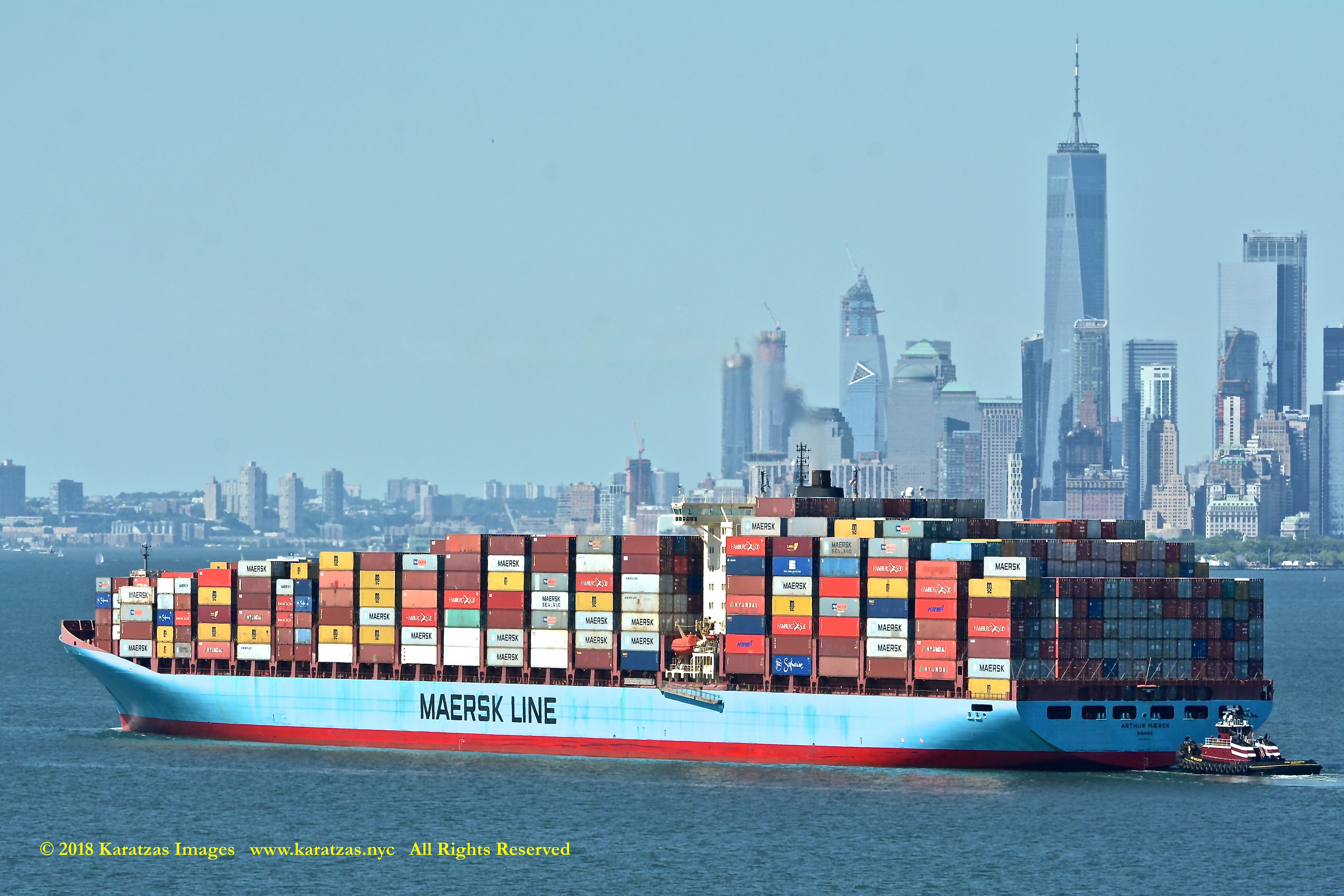
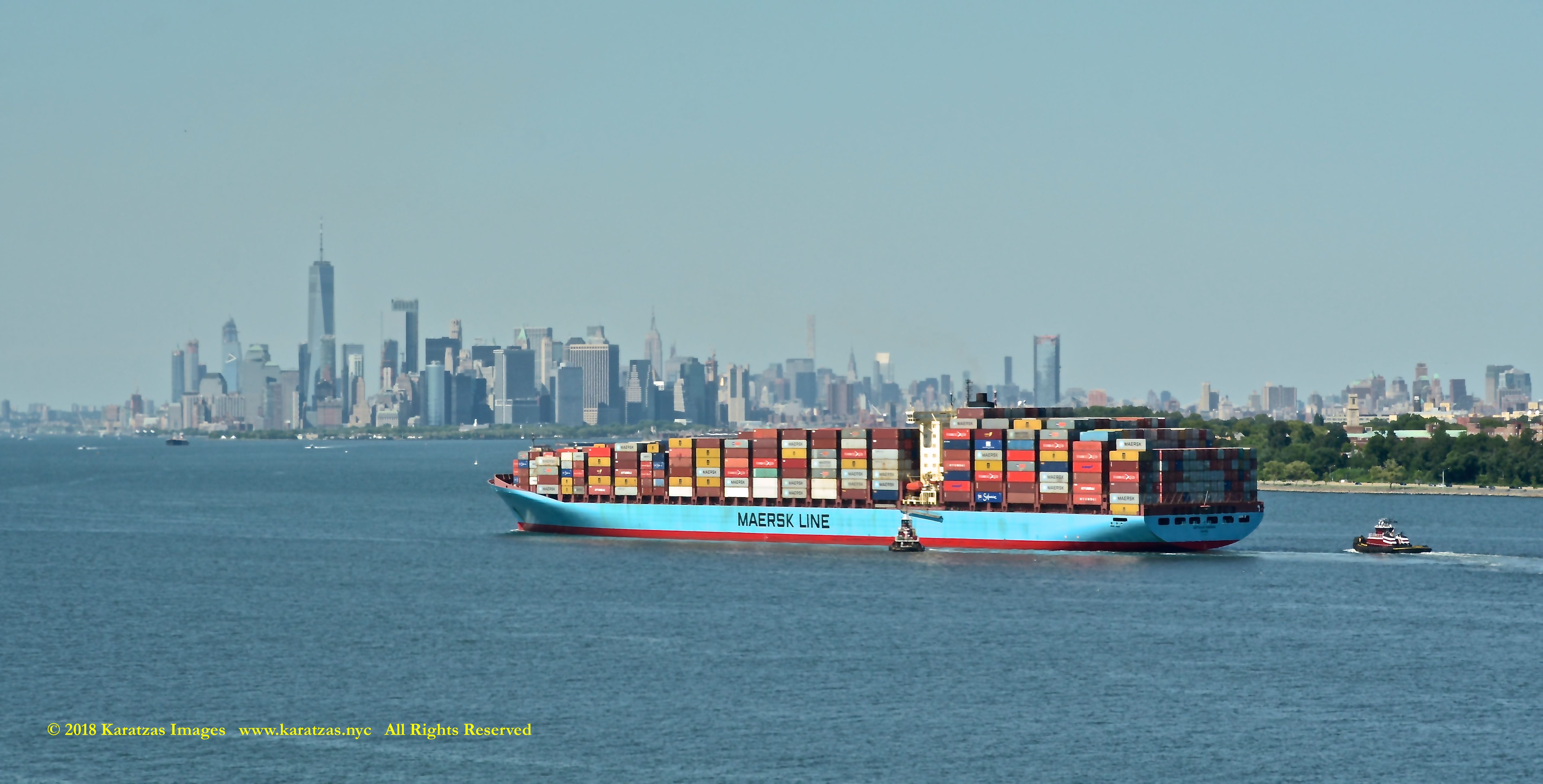
Neo-panamax Containership MV ‘Arthur Maersk’ (8,700-teu built in 2003 at Odense Lindo, Denmark) in New York Harbor. Image credit: Karatzas Images

Neo-panamax Containership MV ‘Arthur Maersk’ (8,700-teu built in 2003 at Odense Lindo, Denmark) in New York Harbor. Seen here with the Statue of Liberty. Image credit: Karatzas Images

Neo-panamax Containership MV ‘Arthur Maersk’ (8,700-teu built in 2003 at Odense Lindo, Denmark) in New York Harbor. Seen here with the Statue of Liberty. Image credit: Karatzas Images

Neo-panamax Containership MV ‘Arthur Maersk’ (8,700-teu built in 2003 at Odense Lindo, Denmark) in New York Harbor. Seen here with the Statue of Liberty. Image credit: Karatzas Images

Neo-panamax Containership MV ‘Arthur Maersk’ (8,700-teu built in 2003 at Odense Lindo, Denmark) in New York Harbor. Seen here with the Statue of Liberty. Image credit: Karatzas Images

Neo-panamax Containership MV ‘Arthur Maersk’ (8,700-teu built in 2003 at Odense Lindo, Denmark) in New York Harbor. Seen here with the Statue of Liberty. Image credit: Karatzas Images

Neo-panamax Containership MV ‘Arthur Maersk’ (8,700-teu built in 2003 at Odense Lindo, Denmark) in New York Harbor. Seen here with the Statue of Liberty. Image credit: Karatzas Images

Neo-panamax Containership MV ‘Arthur Maersk’ (8,700-teu built in 2003 at Odense Lindo, Denmark) in New York Harbor. Seen here with the Statue of Liberty. Image credit: Karatzas Images

Neo-panamax Containership MV ‘Arthur Maersk’ (8,700-teu built in 2003 at Odense Lindo, Denmark) in New York Harbor. Seen here with the Statue of Liberty. Image credit: Karatzas Images

Neo-panamax Containership MV ‘Arthur Maersk’ (8,700-teu built in 2003 at Odense Lindo, Denmark) in New York Harbor. Image credit: Karatzas Images

Neo-panamax Containership MV ‘Arthur Maersk’ (8,700-teu built in 2003 at Odense Lindo, Denmark) in New York Harbor. Seen here with One World Trade Center in the backdrop. Image credit: Karatzas Images

Neo-panamax Containership MV ‘Arthur Maersk’ (8,700-teu built in 2003 at Odense Lindo, Denmark) in New York Harbor. Seen here with One World Trade Center in the backdrop. Image credit: Karatzas Images

Neo-panamax Containership MV ‘Arthur Maersk’ (8,700-teu built in 2003 at Odense Lindo, Denmark) in New York Harbor. Seen here with One World Trade Center in the backdrop. Image credit: Karatzas Images

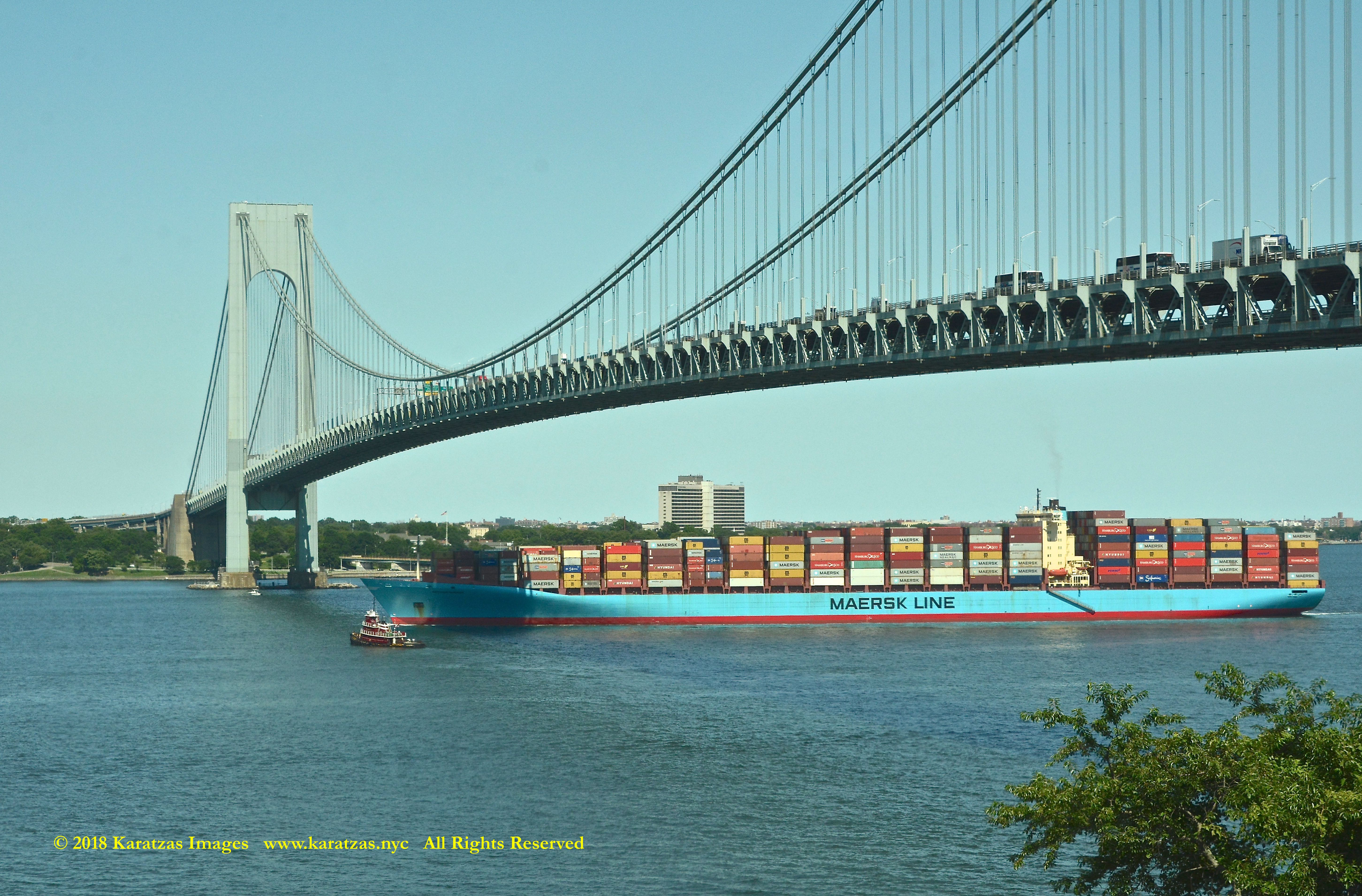
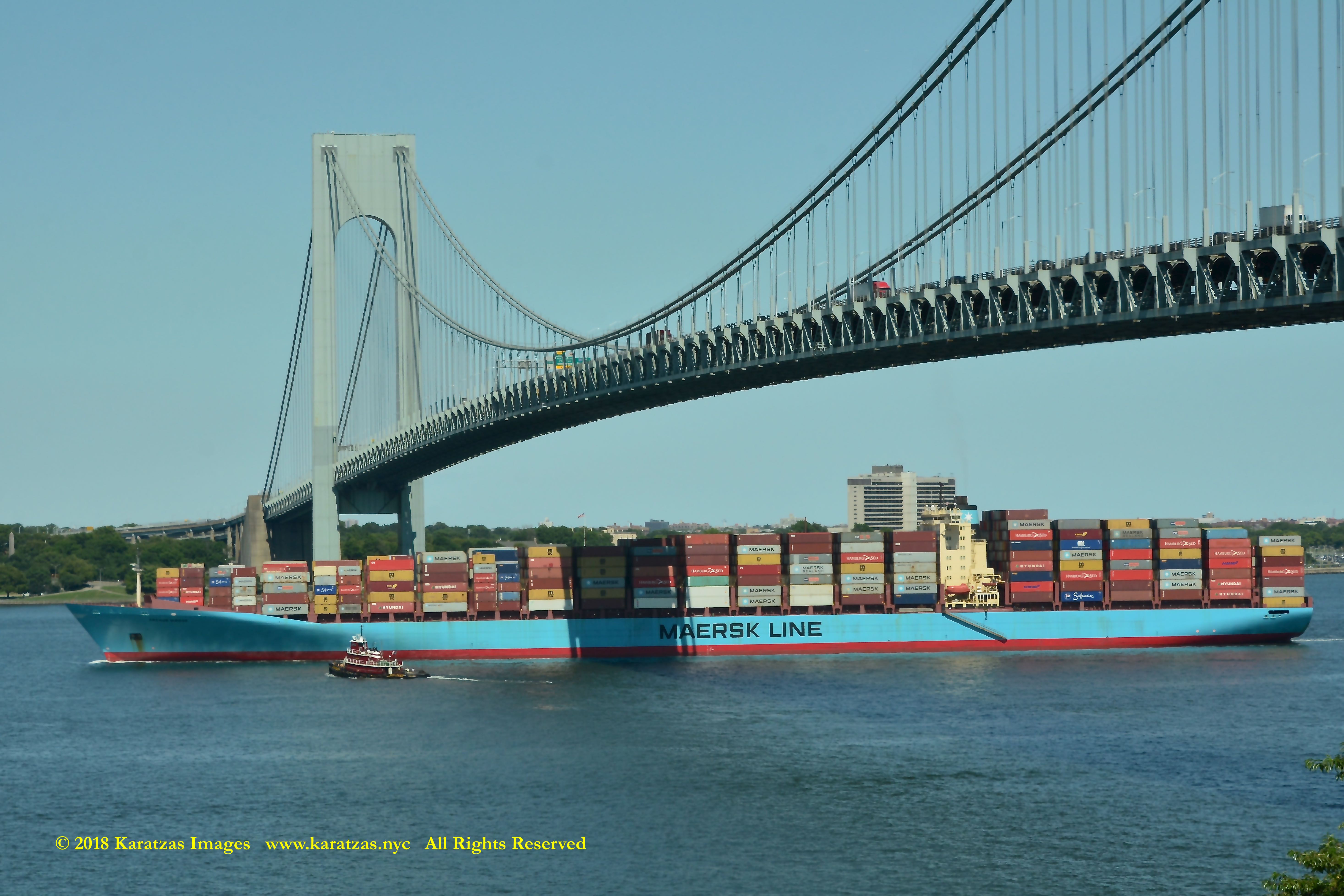
Neo-panamax Containership MV ‘Arthur Maersk’ (8,700-teu built in 2003 at Odense Lindo, Denmark) in New York Harbor. Seen here with the Verrazzano-Narrows Bridge. Image credit: Karatzas Images

Neo-panamax Containership MV ‘Arthur Maersk’ (8,700-teu built in 2003 at Odense Lindo, Denmark) in New York Harbor. Seen here with the Verrazzano-Narrows Bridge. Image credit: Karatzas Images

© 2013 – present Basil M Karatzas & Karatzas Images. All Rights Reserved.

IMPORTANT DISCLAIMERS: The purpose of this blog is for entertainment and information purposes. Vessel description(s), if any, is/are provided in good faith and believed to be correct and accurate but no assurances, warranties or representations are made herewith. Any vessel description(s) is/are provided for entertainment purposes only. We assume no responsibility whatsoever for any errors / omissions in vessel description.

Access to this blog signifies the reader’s irrevocable acceptance of this disclaimer. No part of this blog can be reproduced by any means and under any circumstances, whatsoever, in whole or in part, without proper attribution or the consent of the copyright and trademark holders of this website. To purchase rights or merchandise of high resolutions images and art presented here, please visit www.karatzas.nyc or email < info [at] BMKaratzas.com >. Thank you for the consideration.
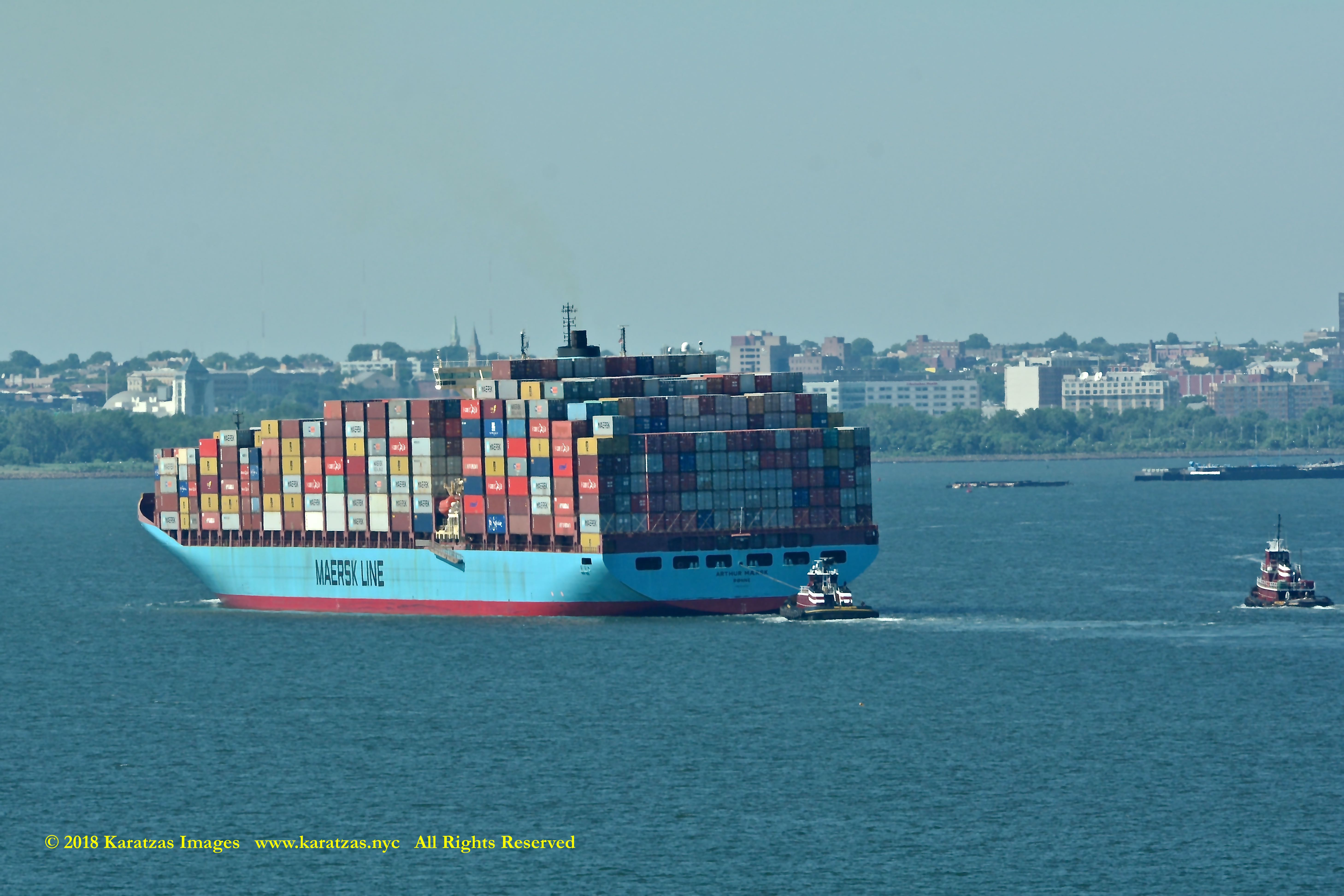
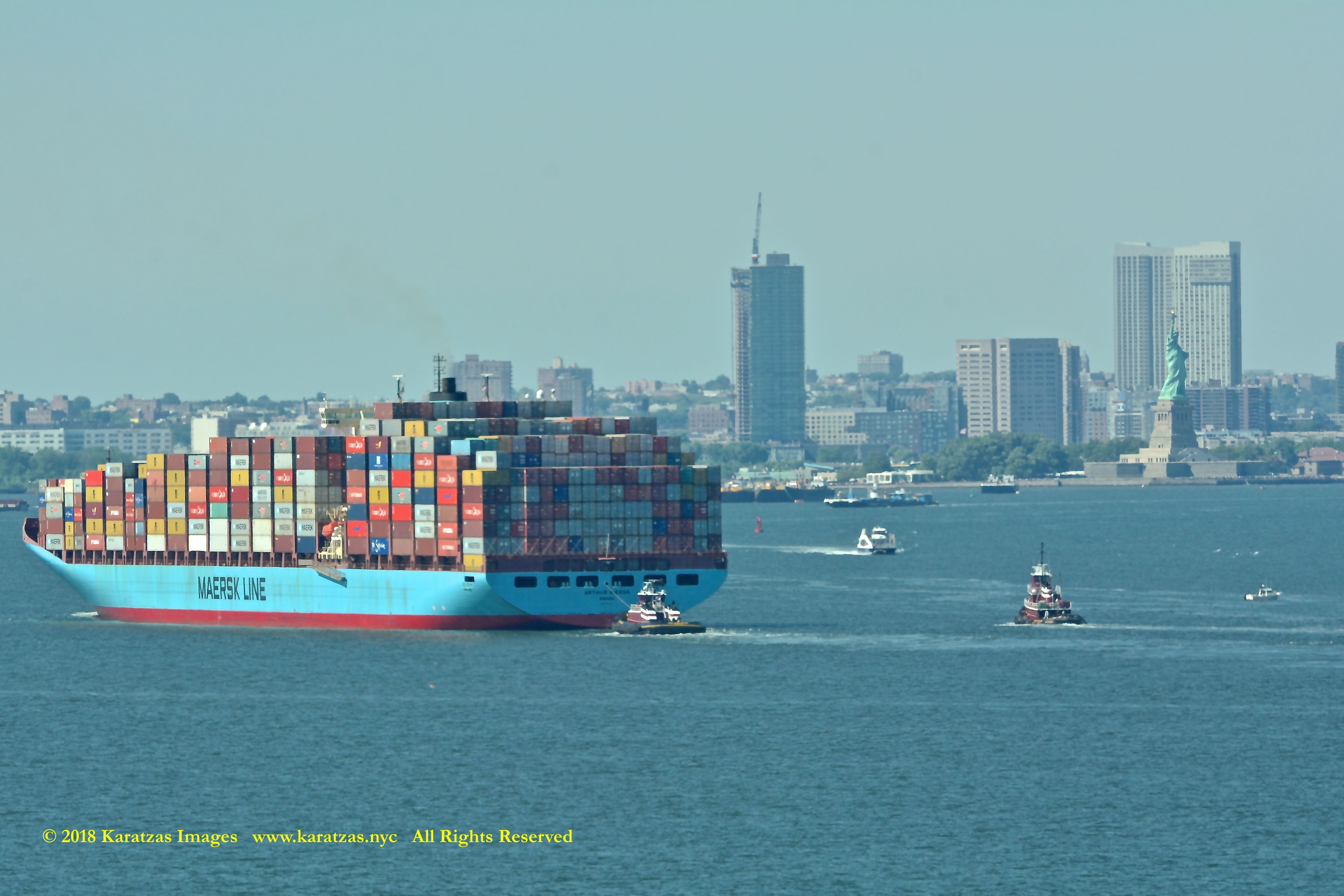
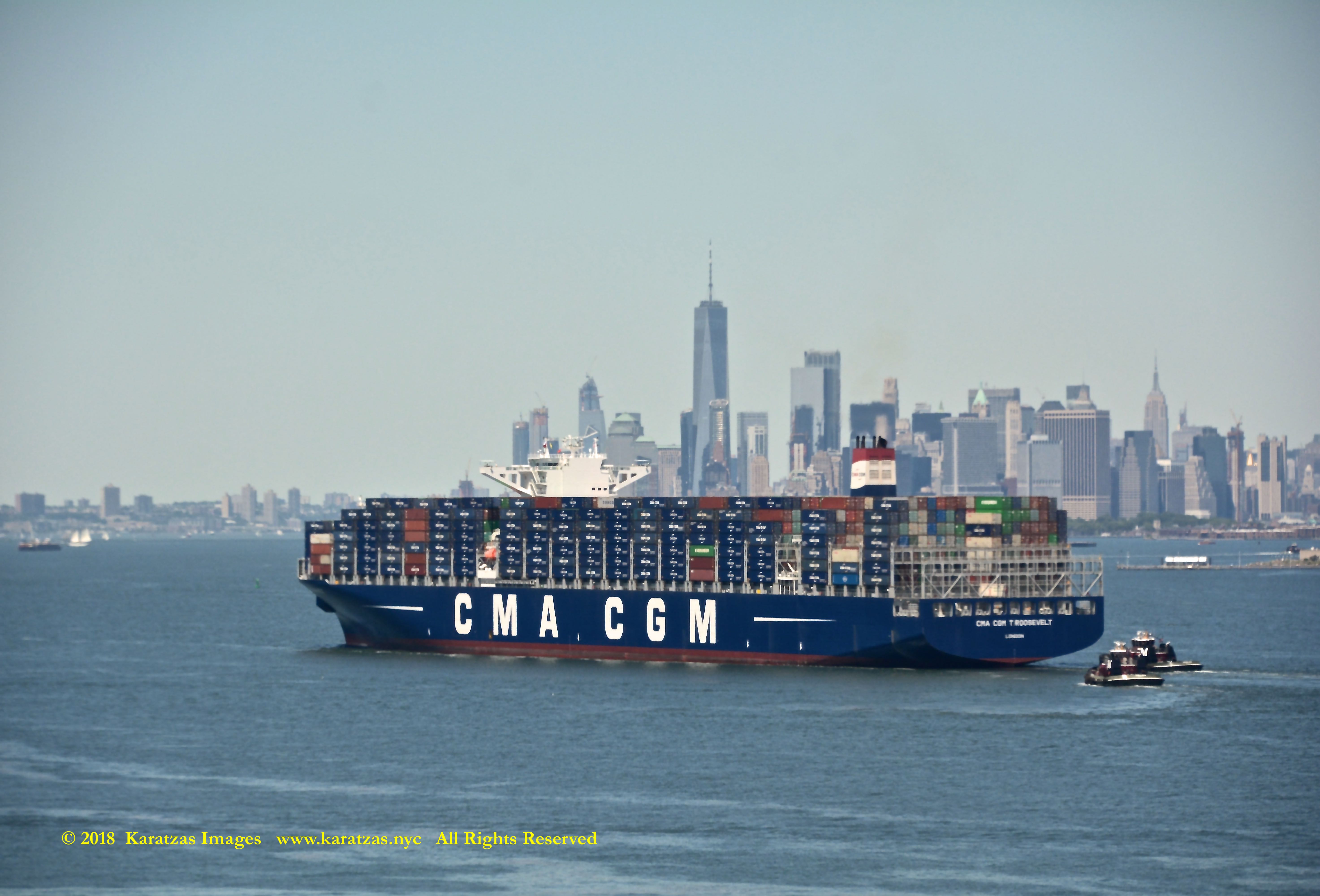
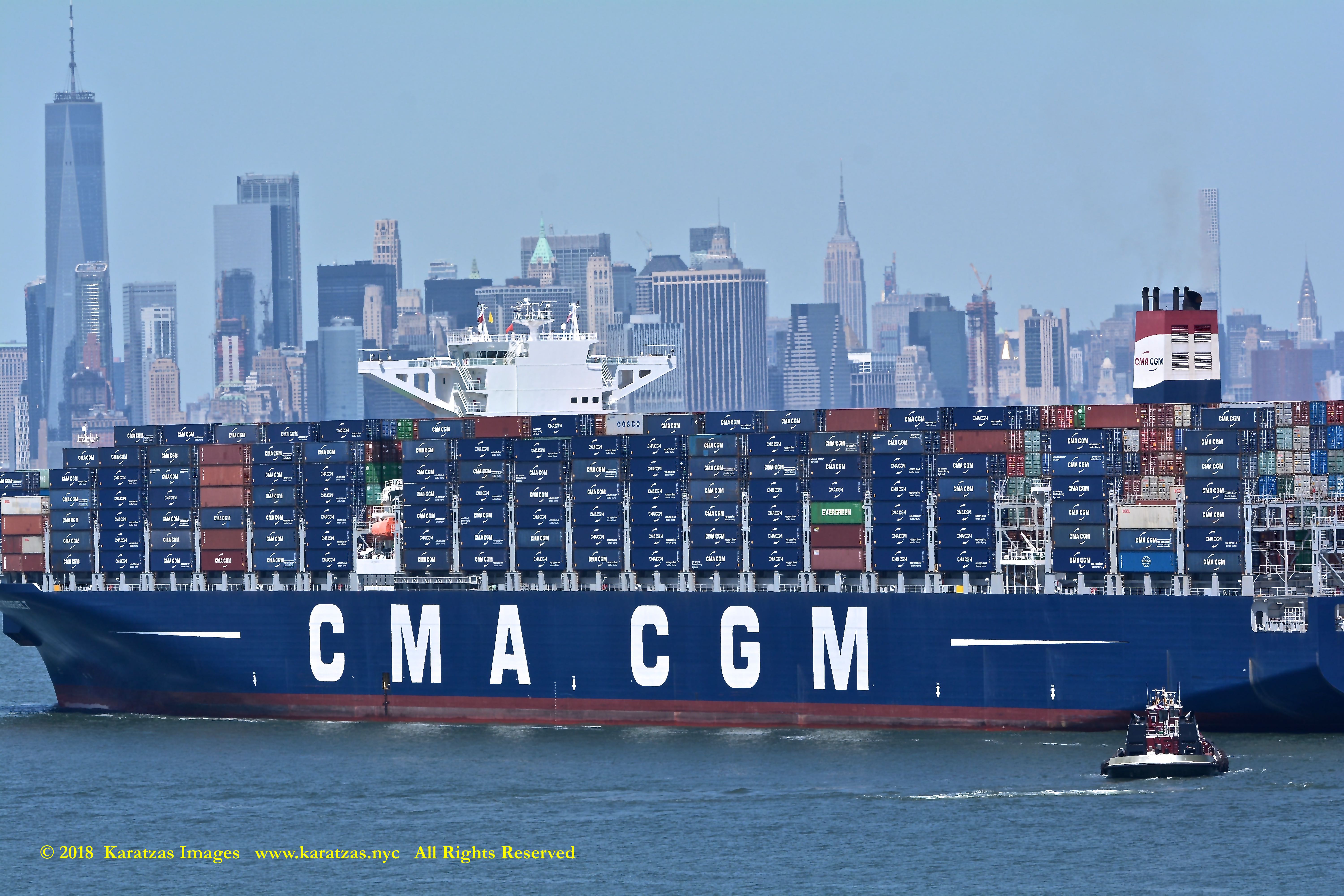
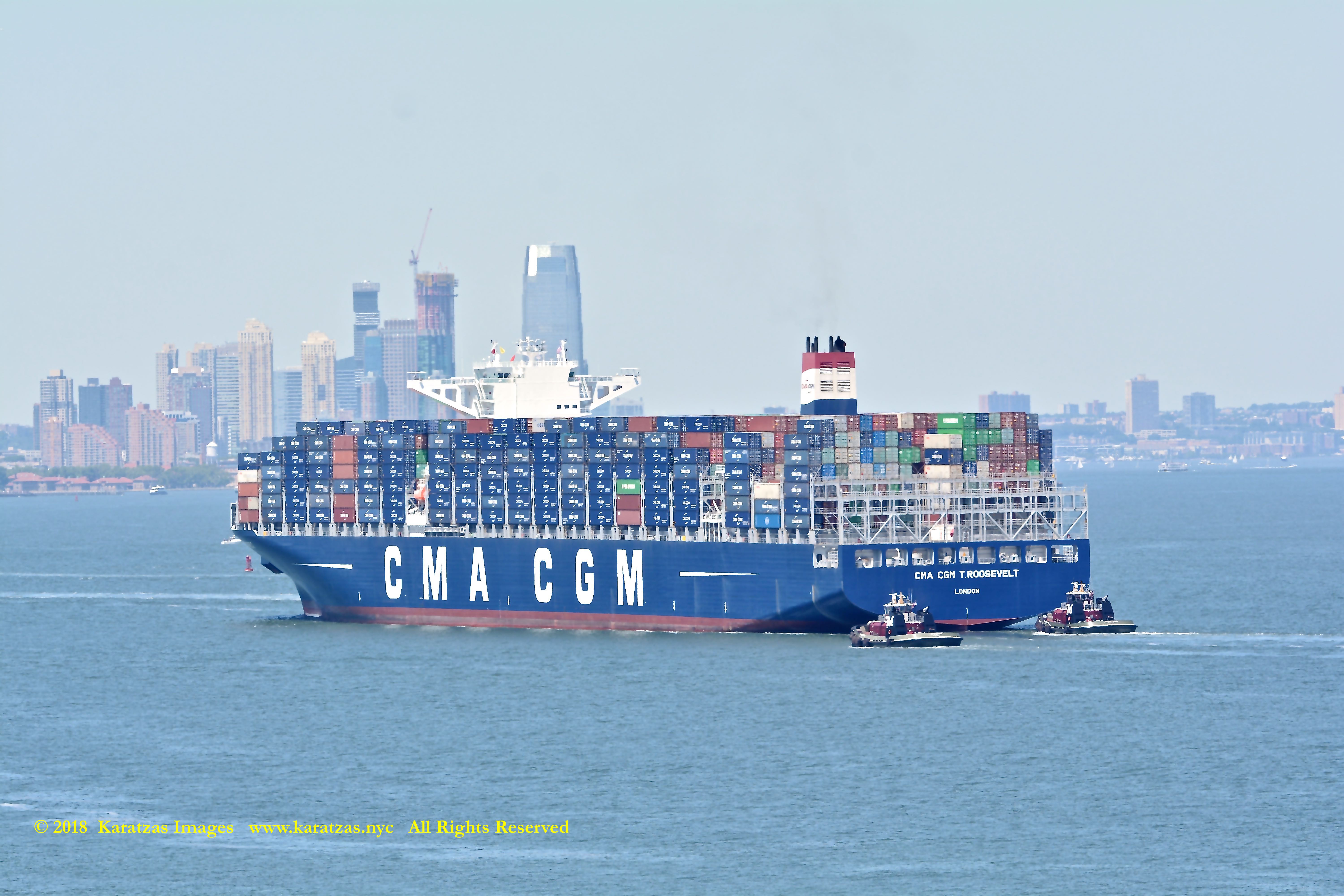
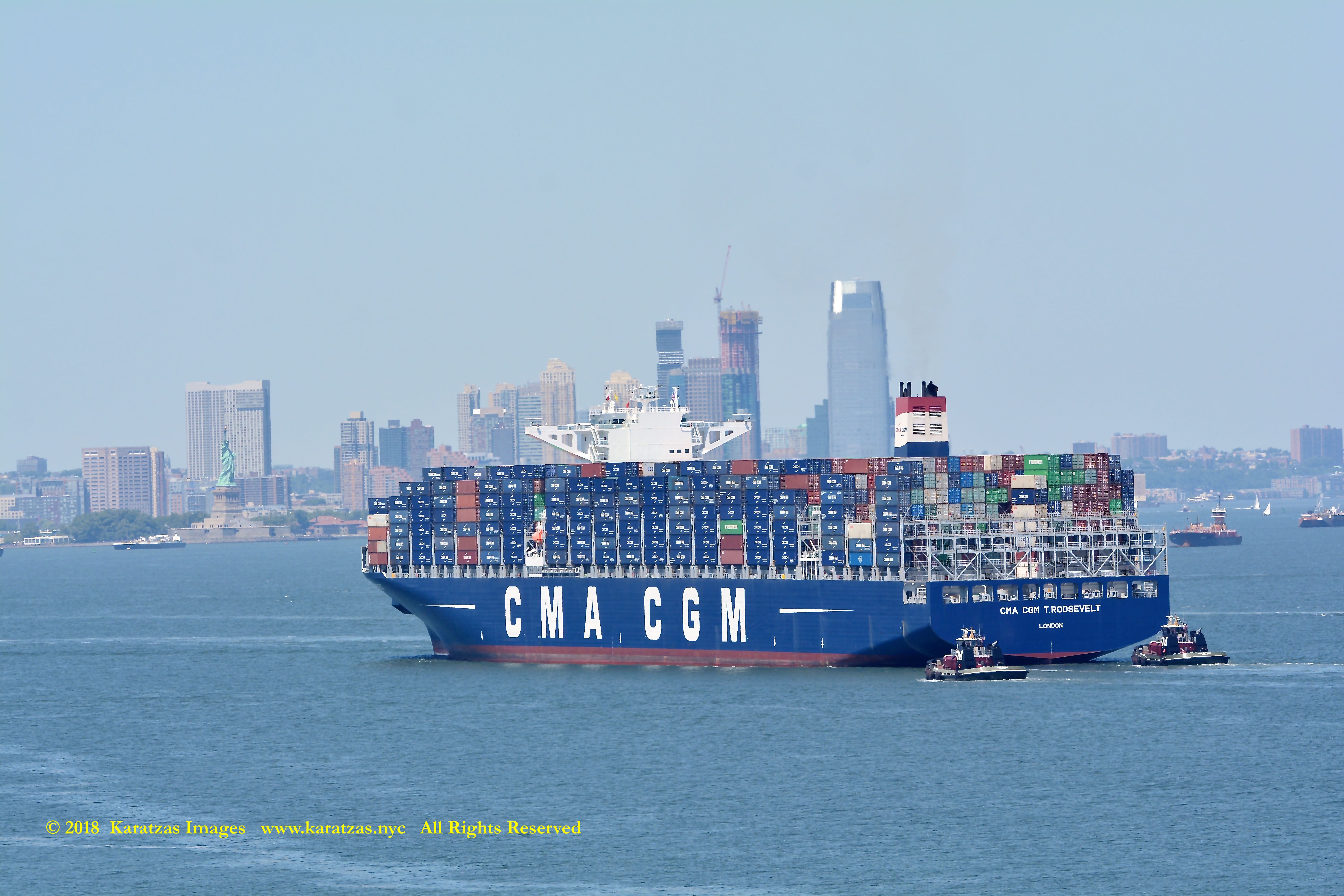
Images of MV ‘CMA CGM T Roosevelt’ in New York Harbor

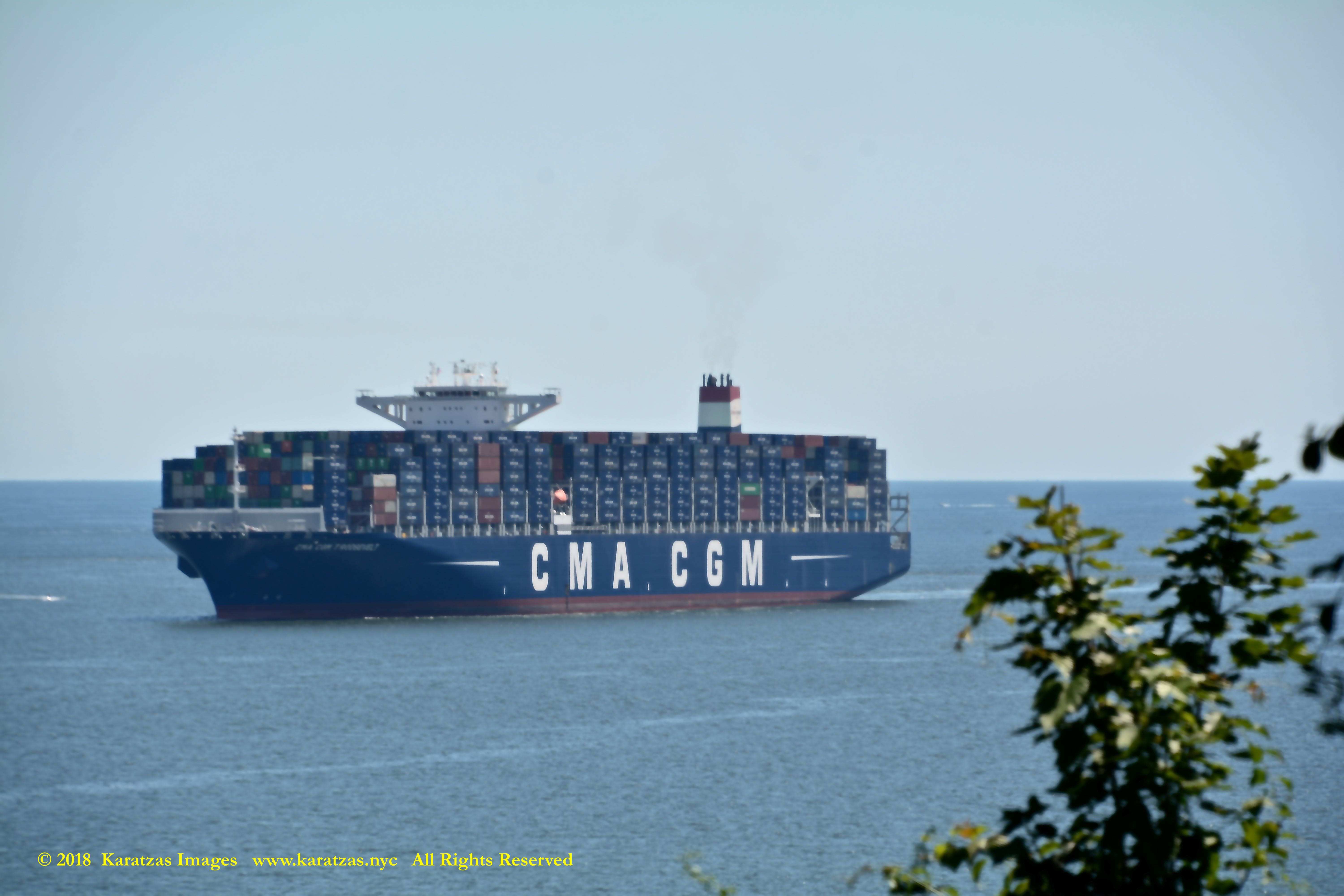
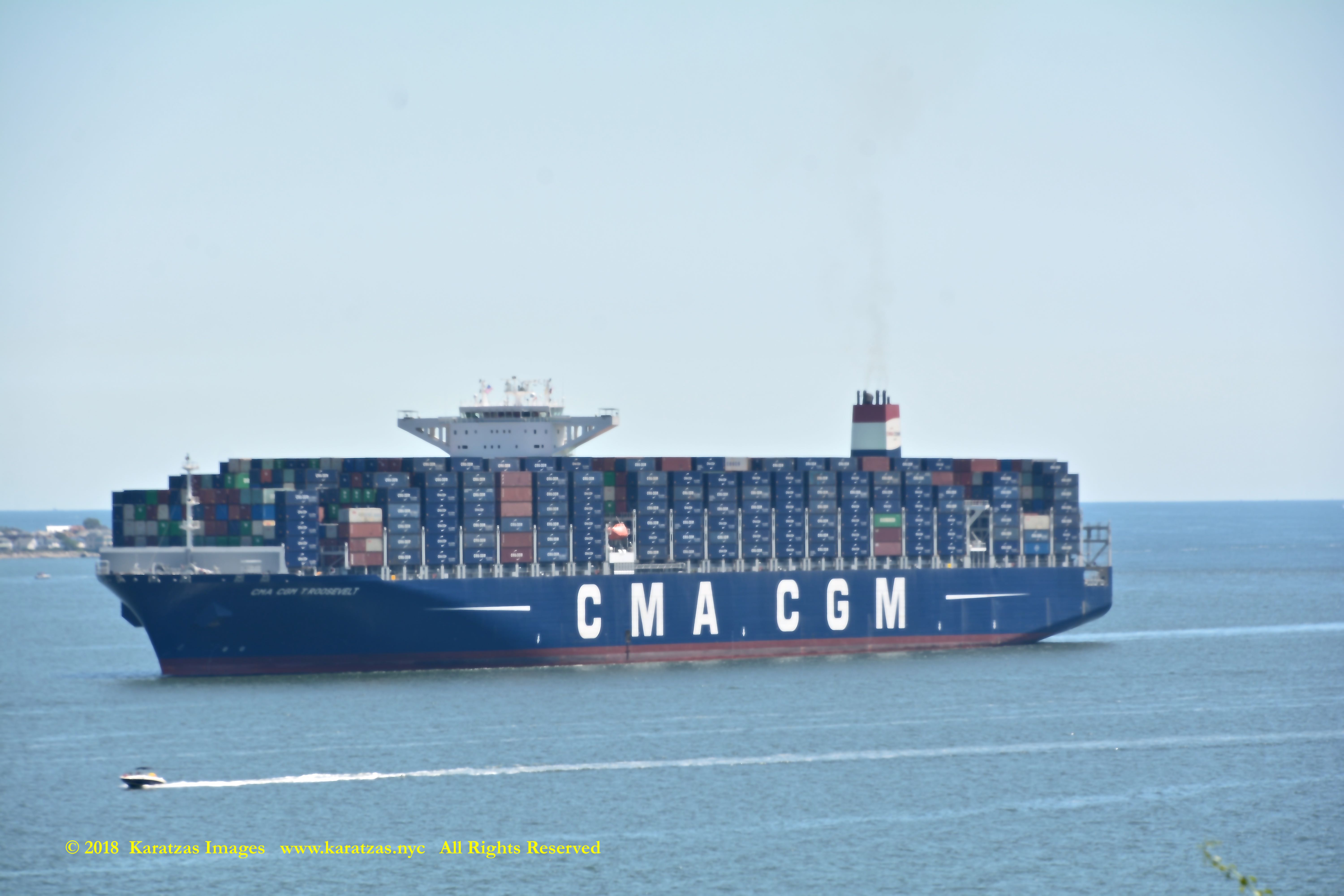
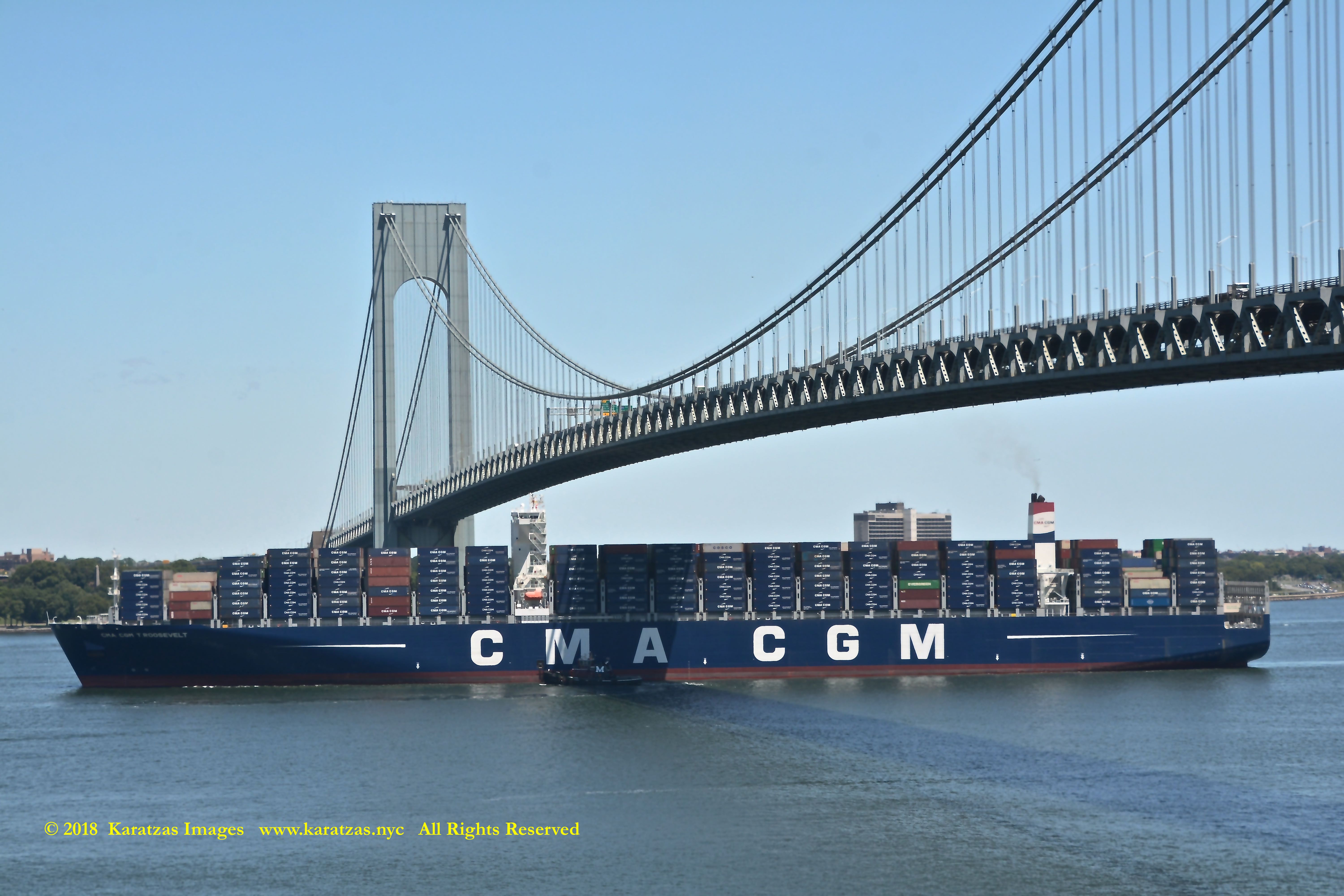
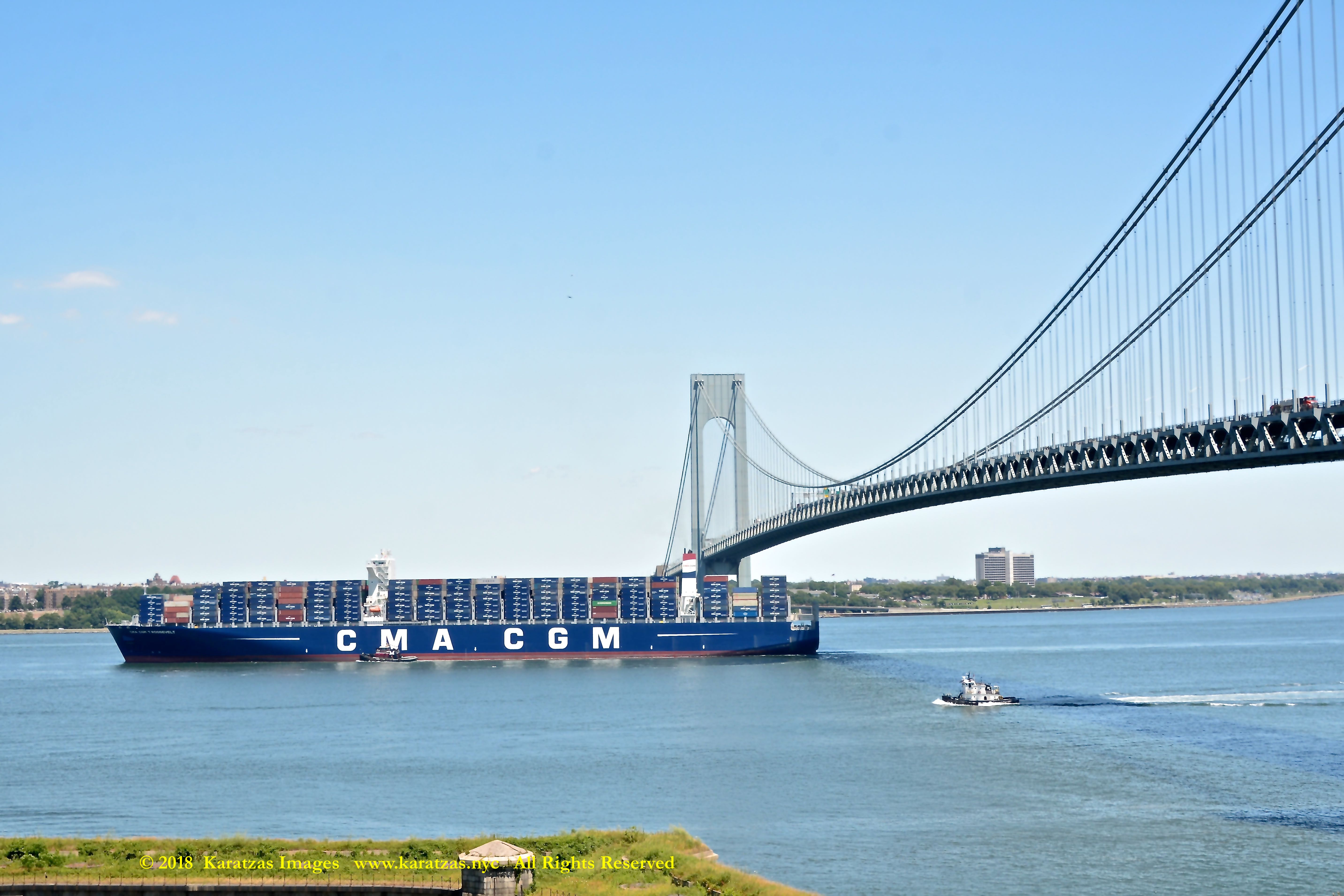
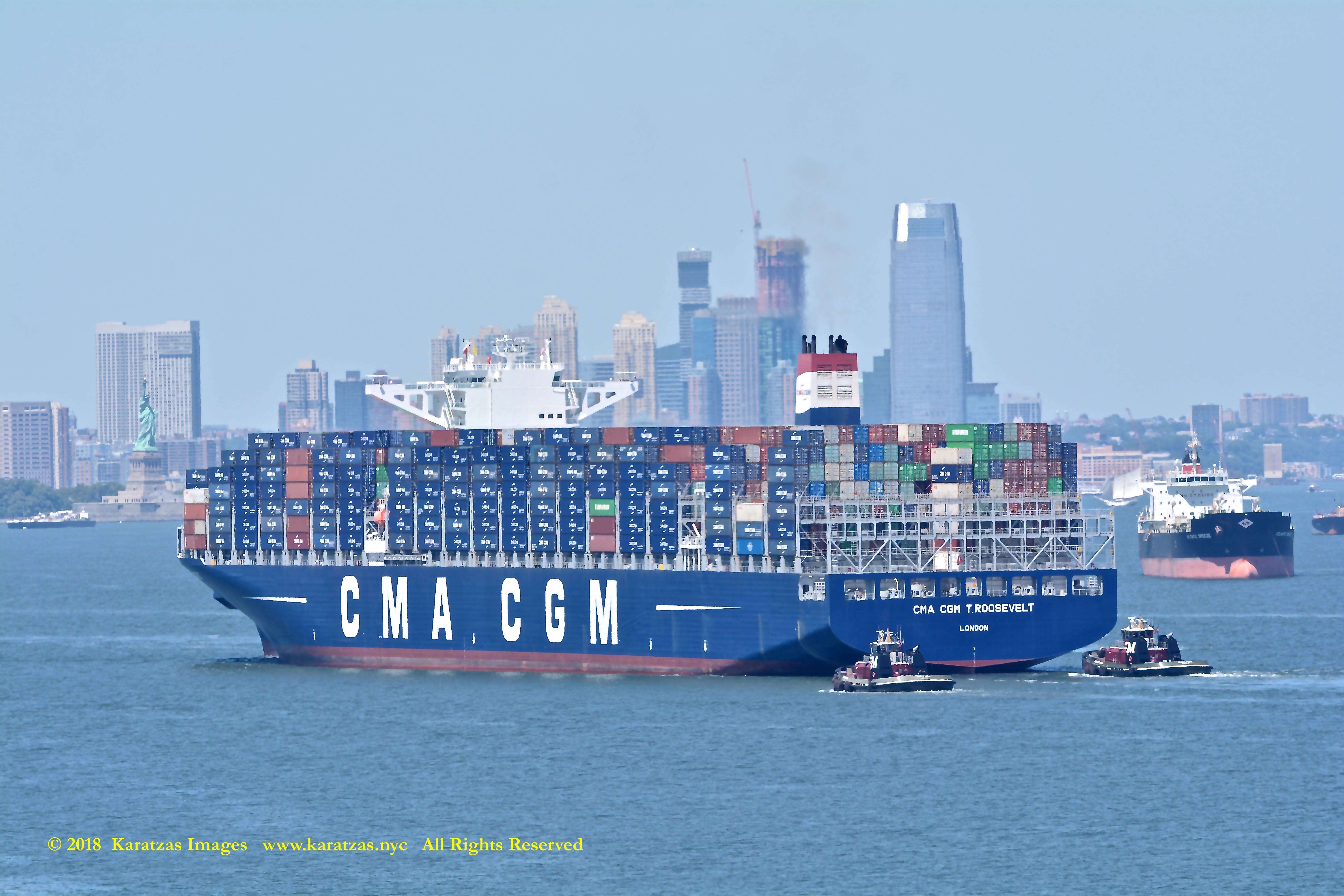
Images of Neo-panamax Containership MV ‘CMA CGM T Roosevelt’ under the Verrazzano-Narrows Bridge, against the World Trade Center and the Lower Manhattan skyline, and by the Statute of Liberty


French containership liner company CMA CGM built six sistership 14,000-teu containerships in 2017 at Hyundai Heavy that have been named after six U.S. Presidents; the vessels are MV ‘CMA CGM G Washington’, MV ‘CMA CGM J Adams’, MV ‘CMA CGM J Madison’, MV ‘CMA CGM T Jefferson’, MV ‘CMA CGM A Lincoln’, MV ‘CMA CGM T Roosevelt’. Images of MV ‘CMA CGM T Roosevelt’ calling New York Harbor can be seen here:

Images of MV ‘CMA CGM A Lincoln’ in New York Harbor, April 17, 2020

It’s been almost a year since the Neo-panamax Containership MV ‘CMA CGM T Roosevelt’ called New York Harbor for the first time; we were there then to take pictures of her Maiden Voyage to New York; please click here for our old posting!


Neo-panamax Containership, 14,500-TEU, built in 2017 at Hyundai HI (Ulsan)


VESSEL IDENTIFICATION & DESCRIPTION: Launch Name was CMA CGM Theodore Roosevelt. Call Sign MAZS3, IMO Number 9780873. Built at Hyundai HI (Ulsan), United Kingdom Flagged, BV Classed, Length Overall of 365.95 m., Length Between Perpendiculars of 350.00 m., Draught of 16.00 m., Moulded Depth of 29.85 m. Beam of 48.20 m., Gross Tonnage of 140,872, Tonnage of 64,226 International Net and 146,639 Dwt (long). WinGD Engine, Heavy Fuel Oil, Horsepower of 68,195 HP.

SHIPOWNERS & MANAGERS: CMA-CGM SA, Marseille, France.

VESSEL SPECIALIZED DETAILS: Teu Capacities of 14,500 Total, 9,230 Homogeneous and 2,800 Reefer, Ship is able to transit the newly expanded locks of the Panama Canal (Neo-panamax @ 14,000-teu).

MAIN ENGINE: 1 x Diesel – WinGD 10X92 – 2-stroke 10-cyl. 920mm x3468mm bore/stroke 50,190mkW total at 78rpm.

PROPULSION & POSITIONING: 1 x FP Propeller (Aft Centre) (mechanical) (Bronze), HHI – Hyundai EMD, 78rpm. 2 x Pos, Tunnel Thruster (Fwd.) (electric) at 5,000ekW total.
The neo-panamax containership MV ‘CMA CGM Theodore Roosevelt’ is making her maiden voyage to the East Coast of the United States. At 14,500 teu capacity, the vessel belongs to the new asset class of containerships with maximum capacity to cross the expanded locks of the Panama Canal. The call of the containership MV ‘CMA CGM Theodore Roosevelt’ to New York and Port Elizabeth in New Jersey is historic, as she is the largest vessel to pass under the raised Bayonne Bridge and the largest containership to call ever call New York and New Jersey. In June 2017, the 10,000-teu containership MV ‘ZIM Antwerp’ was among the first post-panamax vessels ever having to utilize the bridge’s new airdraft and raised roadway.  In mid-July 2017, the 13,2000-teu containership MV ‘OOCL Berlin’ was the first neo-panamax, and largest boxship until that time, to pass under the Bayonne Bridge. The Bayonne Bridge after almost five years of works, a budgeted cost of $1.3 billion for the project, had her roadway raised by 64 feet in order to allow new-panamax containerships to pass below; new airdraft 219.8 ft, 76.0 m. The Bayonne Bridge connects New Jersey and Staten Island (New York) over the Kill Van Kull Strait.

Here the images are from the containership MV ‘CMA CGM T Roosevelt’ passing under the Verrazzano-Narrows Bridge (connecting Staten Island and Brooklyn) and photographed against the Lower Manhattan skyline, the World Trade Center and the Statue of Liberty. For those not familiar with the New York region, the Verrazzano-Narrows Bridge is the first bridge a ship to encounter when entering the harbor, and effectively almost all vessels calling the port have to pass under. Verrazzano-Narrows Bridge’s airdraft of 230.0  ft (70.1 m) is high enough to be a concern only to large cruiseships calling New York.

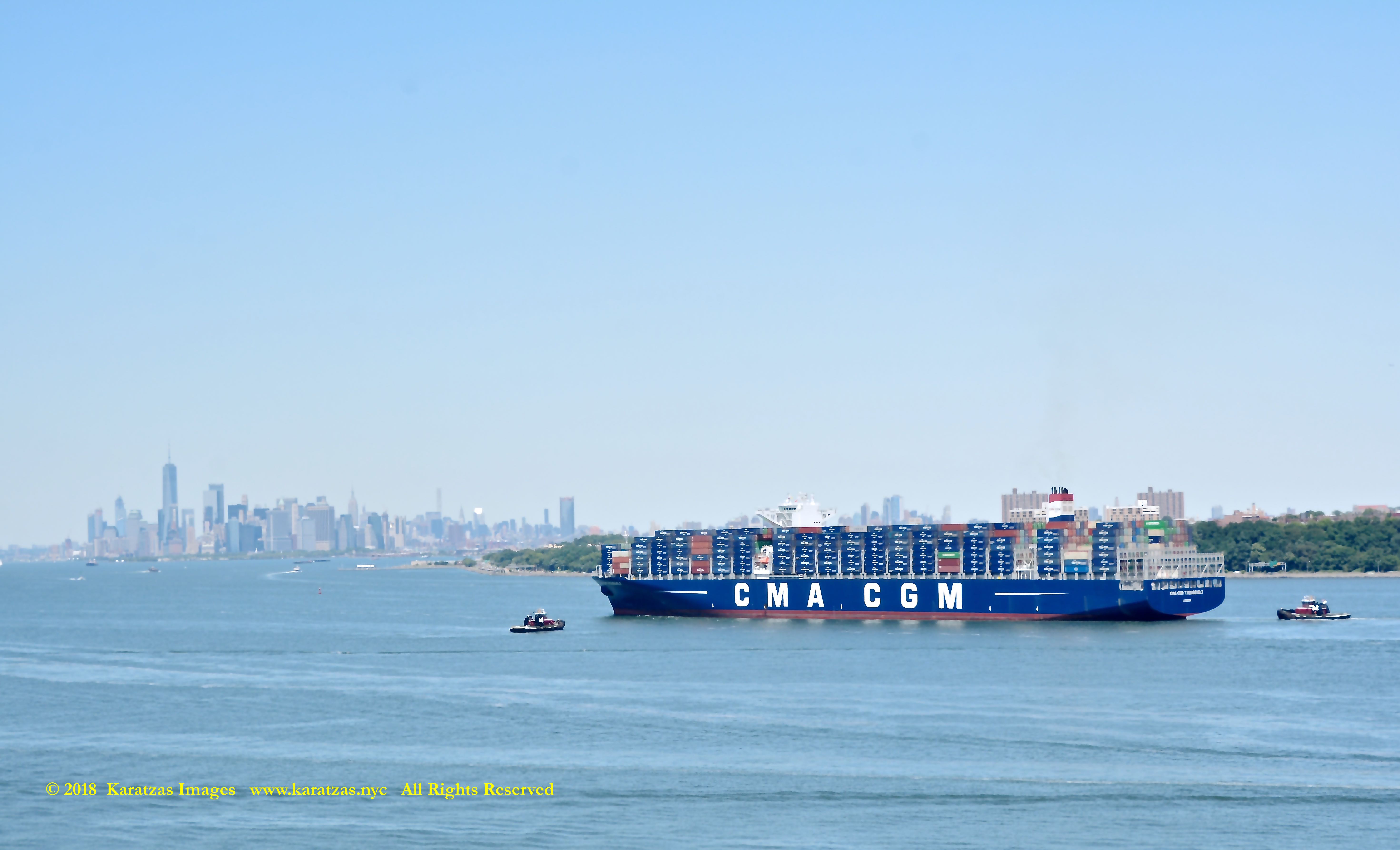
Neo-panamax containership MV ‘CMA CGM T Roosevelt’ entering the New York Harbor. Image credit: Karatzas Images

Neo-panamax containership MV ‘CMA CGM T Roosevelt’ entering the New York Harbor. Image credit: Karatzas Images

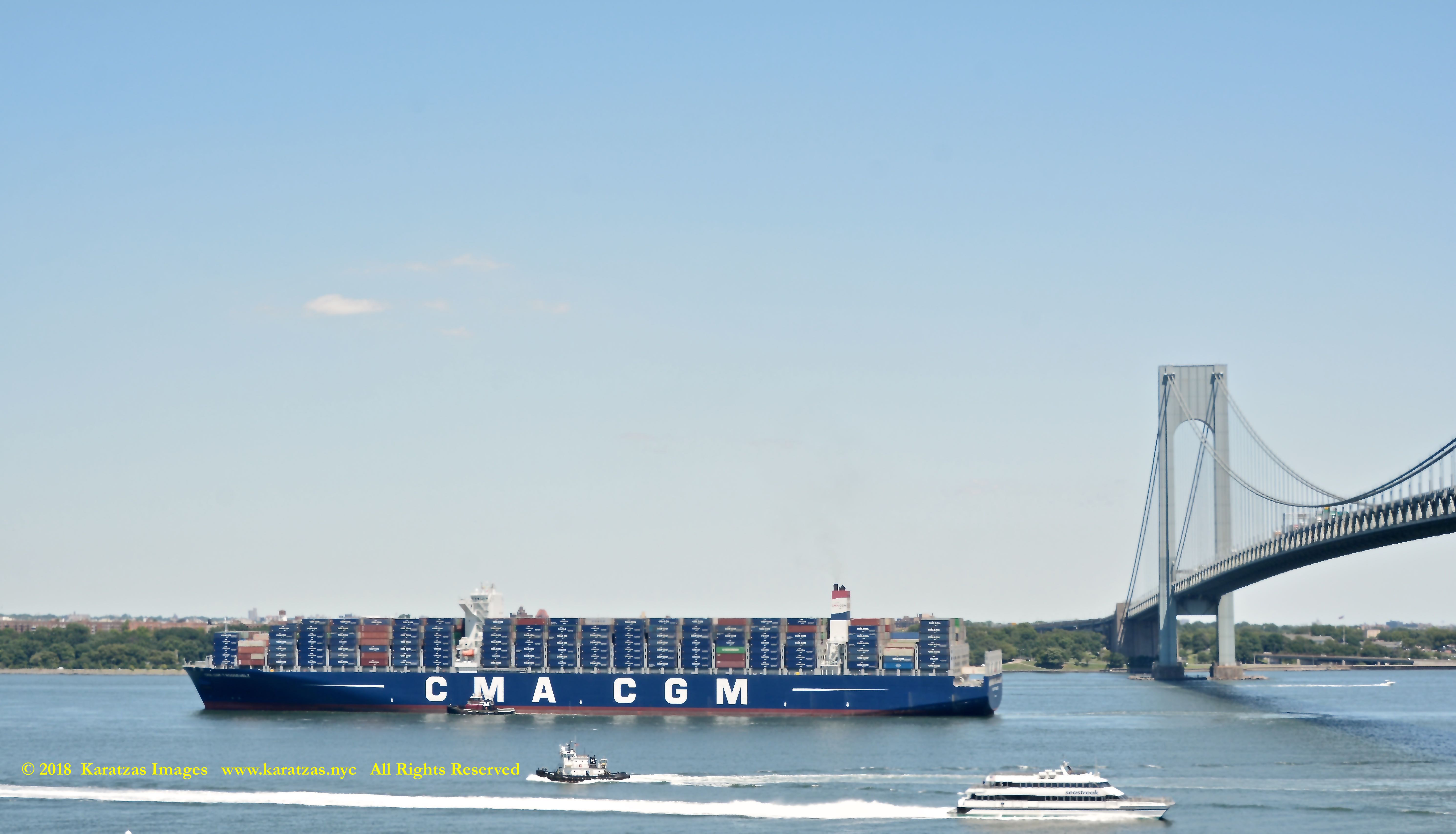
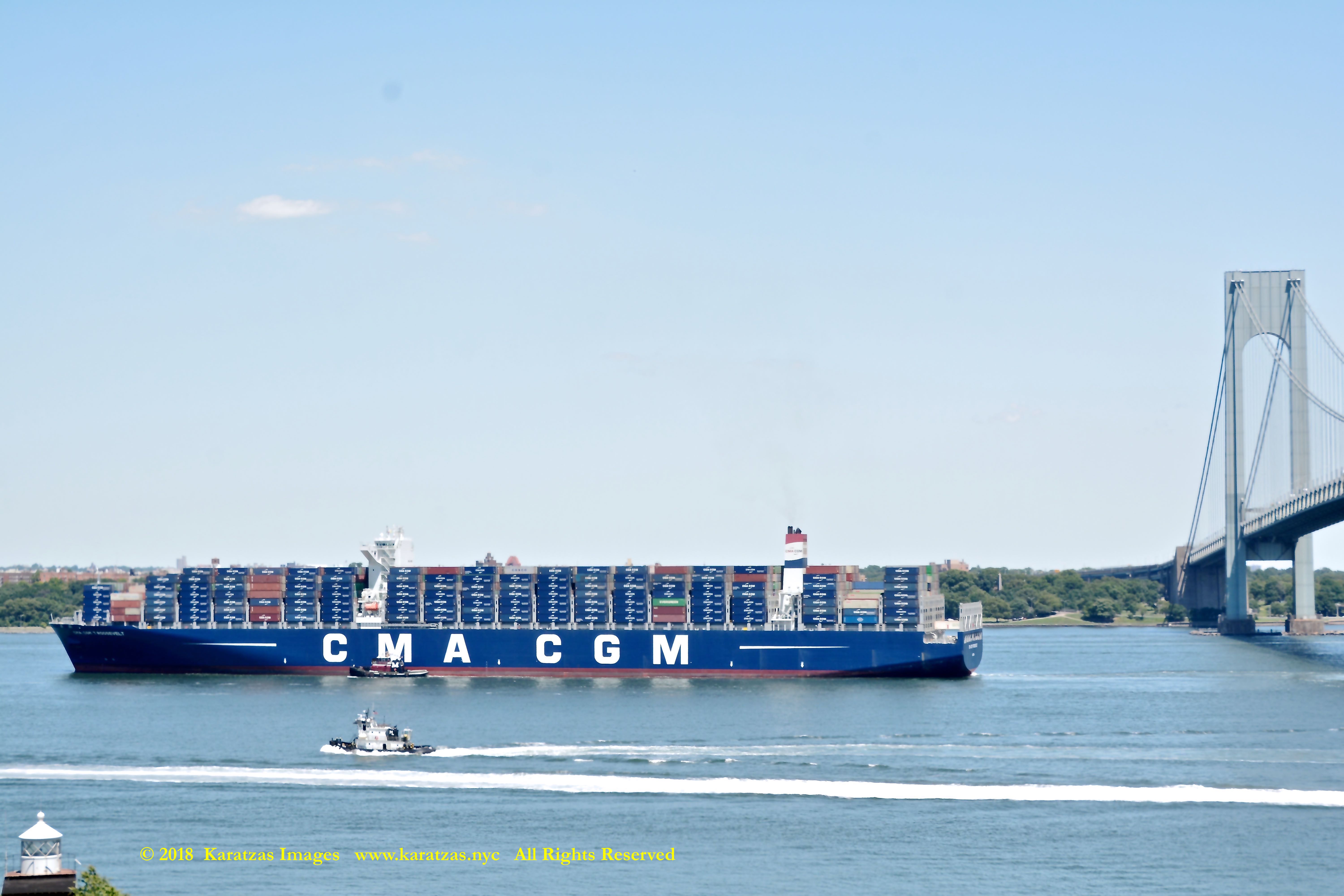
Neo-panamax containership MV ‘CMA CGM T Roosevelt’ entering the New York Harbor. Seen here under the Verrazzano-Narrows Bridge. Image credit: Karatzas Images

Neo-panamax containership MV ‘CMA CGM T Roosevelt’ entering the New York Harbor. Seen here under the Verrazzano-Narrows Bridge. Image credit: Karatzas Images

Neo-panamax containership MV ‘CMA CGM T Roosevelt’ entering the New York Harbor. Seen here under the Verrazzano-Narrows Bridge. Image credit: Karatzas Images

Neo-panamax containership MV ‘CMA CGM T Roosevelt’ entering the New York Harbor. Seen here under the Verrazzano-Narrows Bridge. Image credit: Karatzas Images

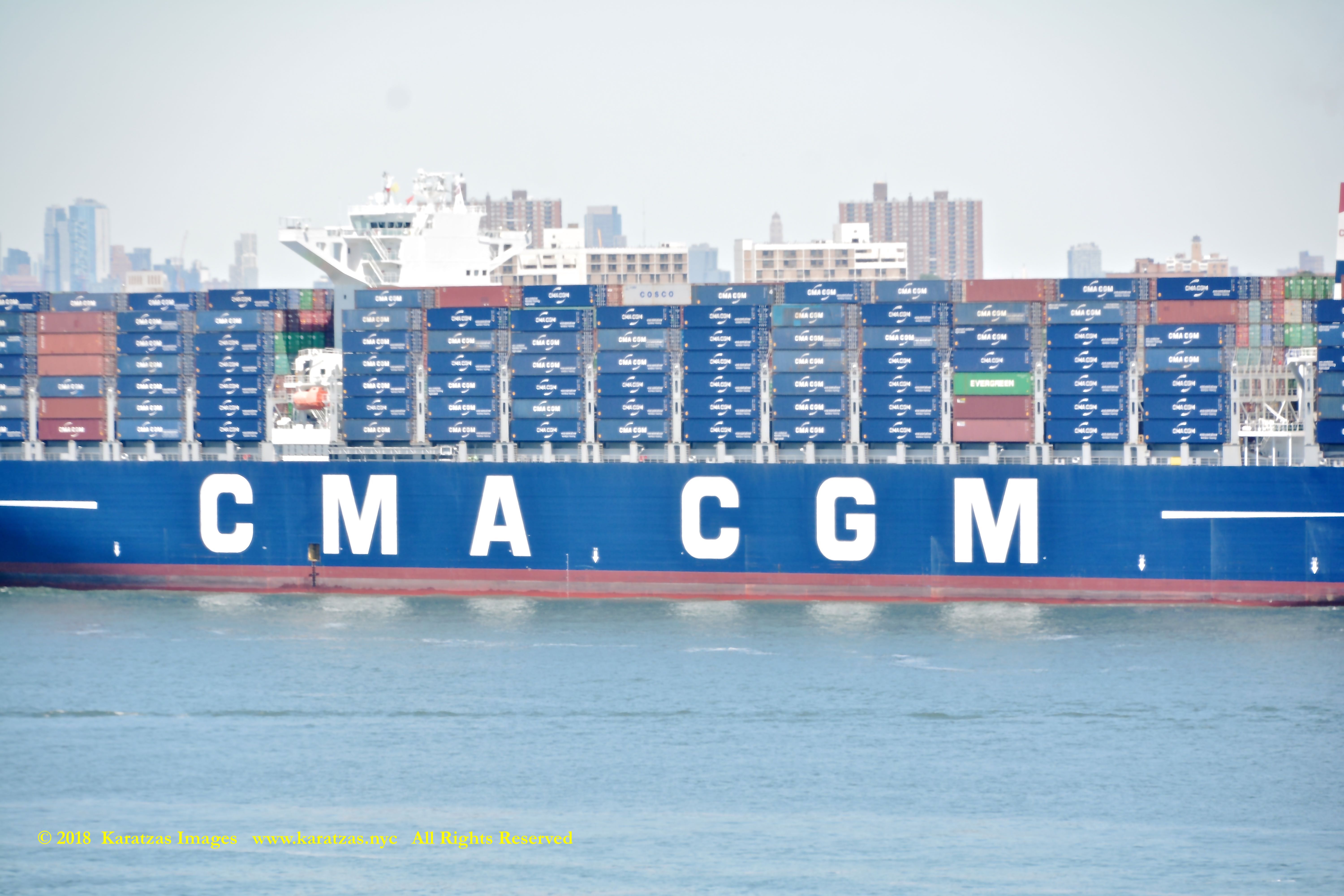
Neo-panamax containership MV ‘CMA CGM T Roosevelt’ entering the New York Harbor. Amidships detail. Image credit: Karatzas Images

Neo-panamax containership MV ‘CMA CGM T Roosevelt’ entering the New York Harbor. Seen here against the Lower Manhattan skyline with the World Trade Center clearly visible. Image credit: Karatzas Images

Neo-panamax containership MV ‘CMA CGM T Roosevelt’ entering the New York Harbor. Seen here against the Lower Manhattan skyline with the World Trade Center dominating the scene. Image credit: Karatzas Images

Neo-panamax containership MV ‘CMA CGM T Roosevelt’ entering the New York Harbor. Seen here against the Lower Manhattan skyline with the World Trade Center dominating the scene. Image credit: Karatzas Images

Neo-panamax containership MV ‘CMA CGM T Roosevelt’ entering the New York Harbor. Image credit: Karatzas Images

Neo-panamax containership MV ‘CMA CGM T Roosevelt’ entering the New York Harbor. Seen here with the Statue of Liberty. Image credit: Karatzas Images

Neo-panamax containership MV ‘CMA CGM T Roosevelt’ entering the New York Harbor. Seen here with the Statue of Liberty. Image credit: Karatzas Images

© 2013 – present Basil M Karatzas & Karatzas Marine Advisors & Co.  All Rights Reserved.

IMPORTANT DISCLAIMERS:  Vessel description is provided in good faith and is believed to be correct and accurate but no assurances, warranties or representations are made herewith. Vessel description is provided for entertainment  purposes only. We have no responsibility whatsoever for any errors / omissions in vessel description.

Access to this blog signifies the reader’s irrevocable acceptance of this disclaimer. No part of this blog can be reproduced by any means and under any circumstances, whatsoever, in whole or in part, without proper attribution or the consent of the copyright and trademark holders of this website. Whilst every effort has been made to ensure that information herewithin has been received from sources believed to be reliable and such information is believed to be accurate at the time of publishing, no warranties or assurances whatsoever are made in reference to accuracy or completeness of said information, and no liability whatsoever will be accepted for taking or failing to take any action upon any information contained in any part of this website.  Thank you for the consideration.
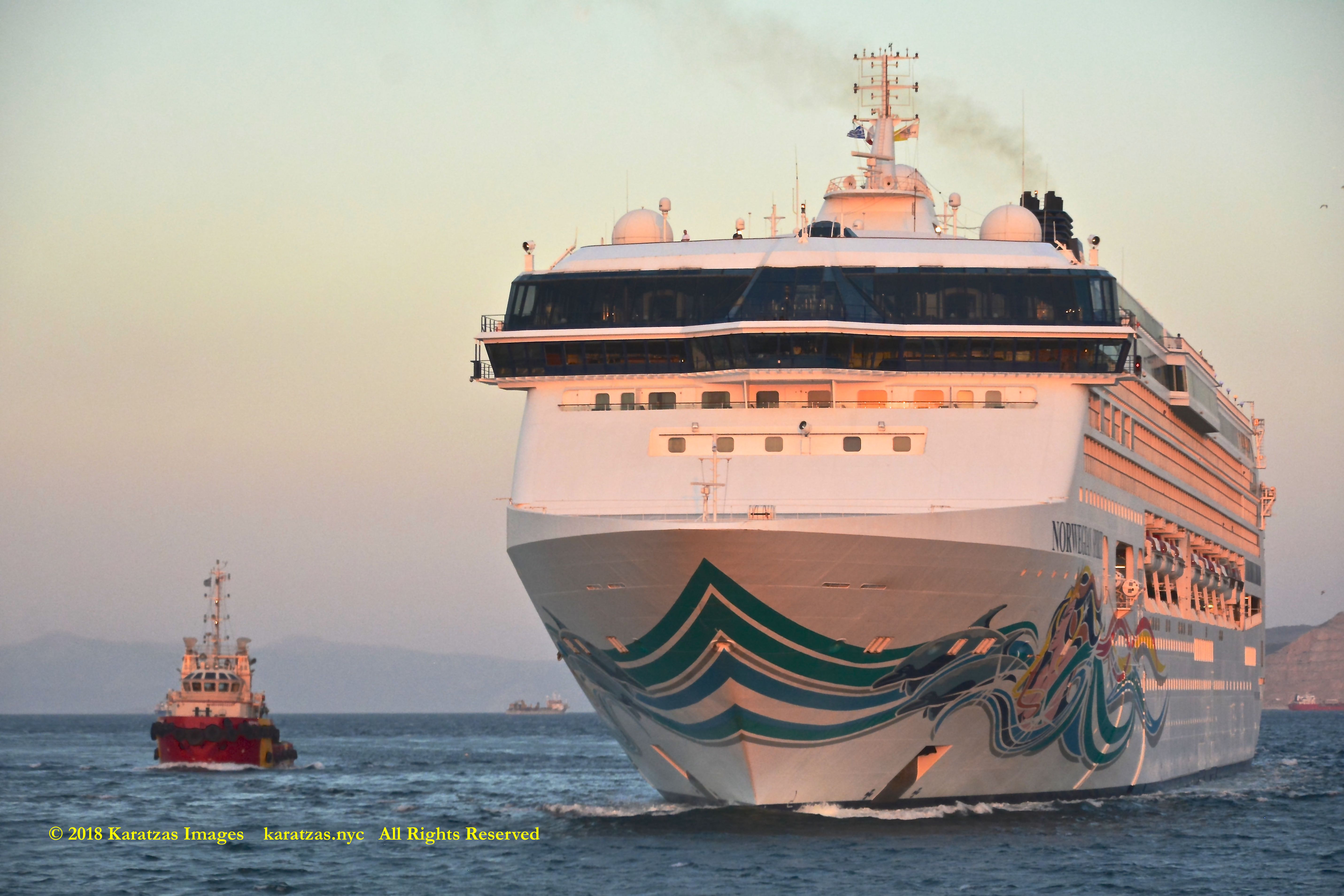
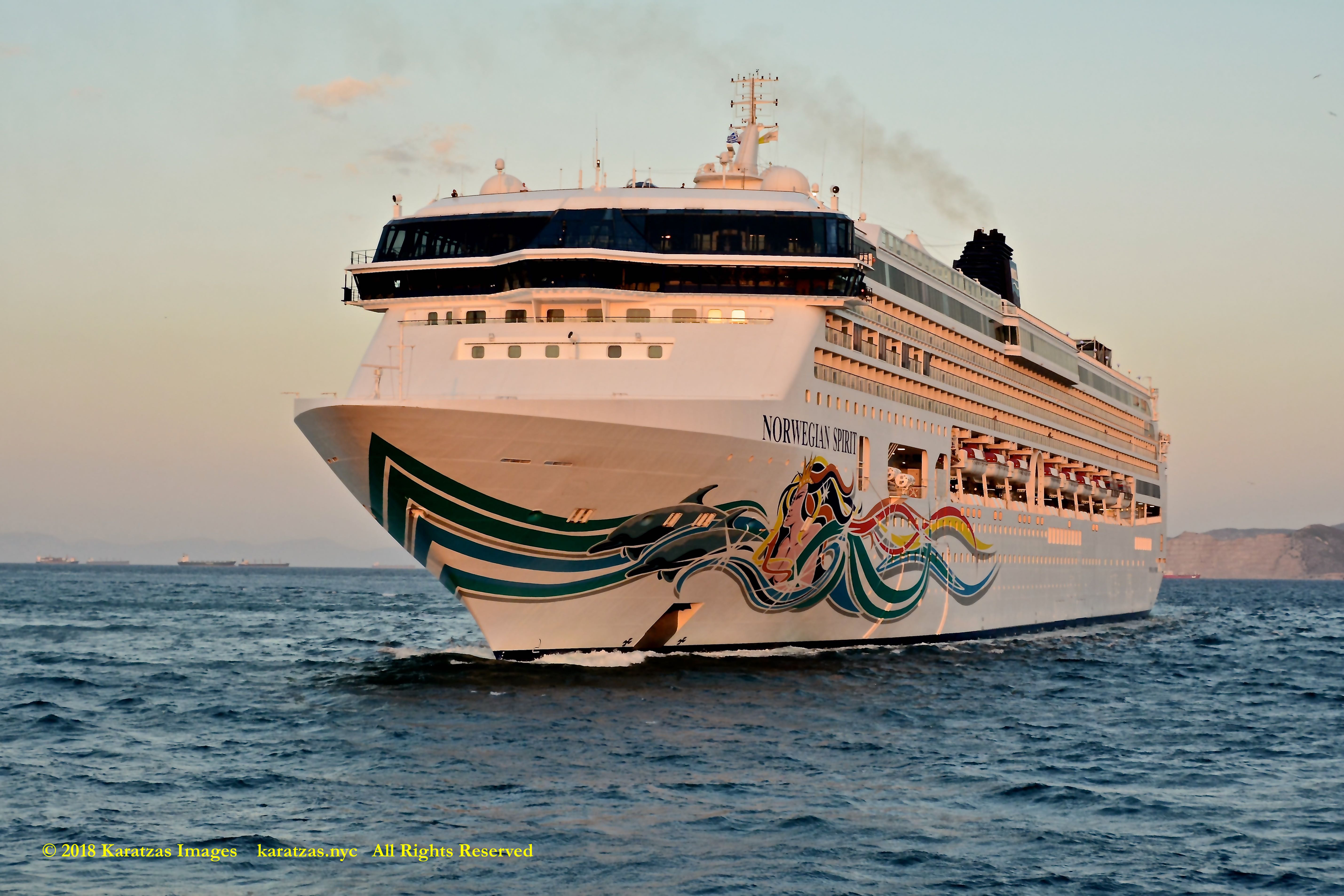
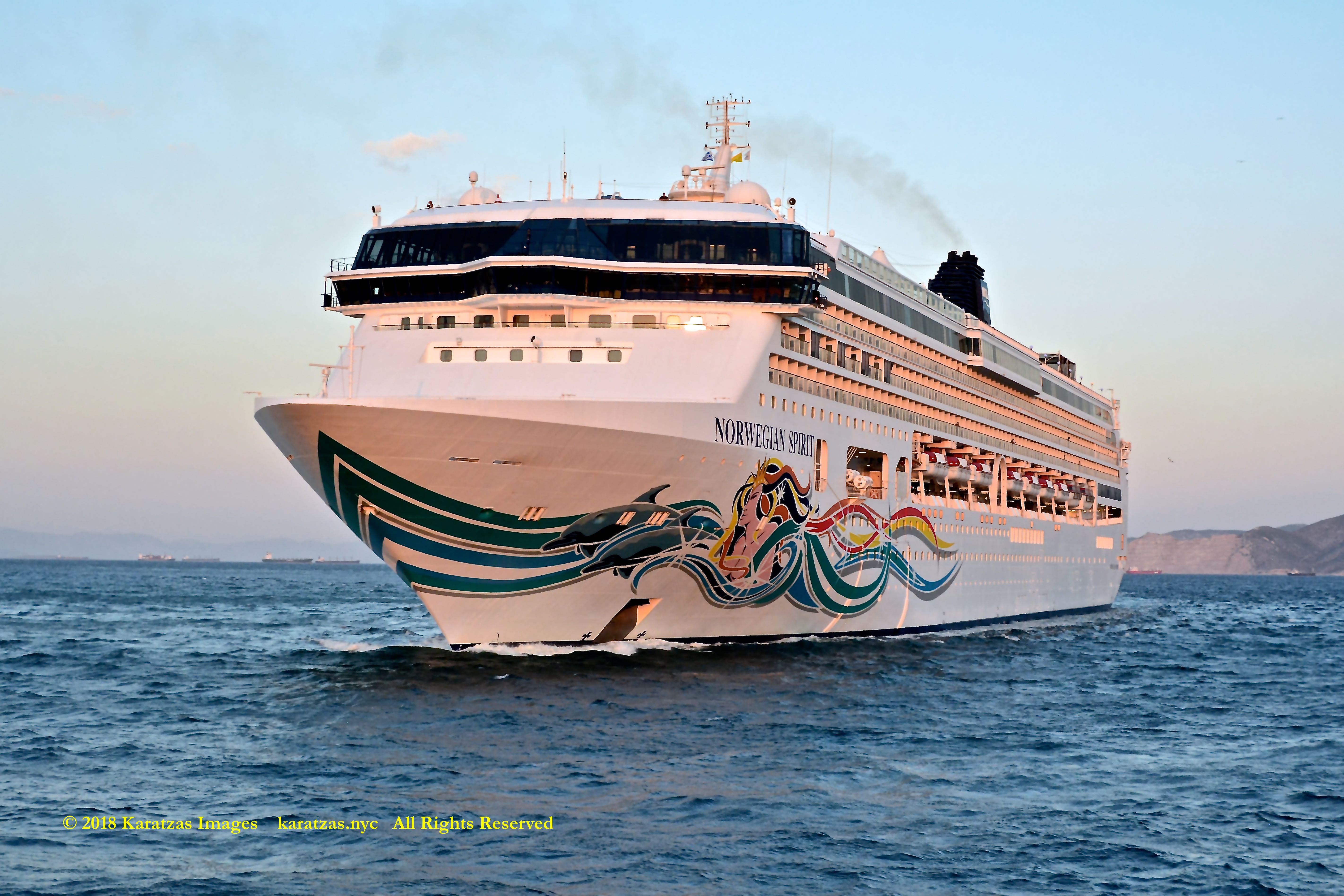
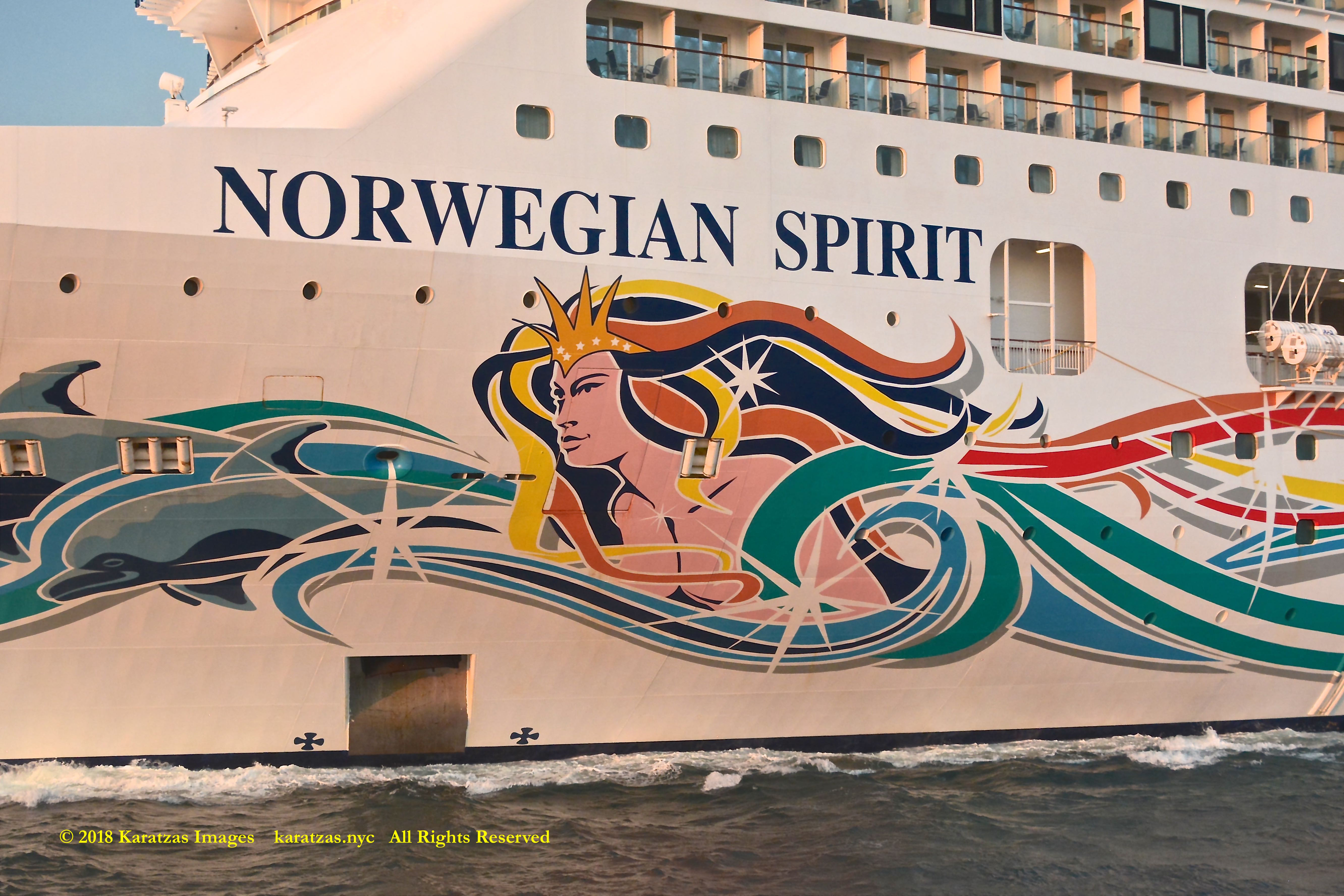
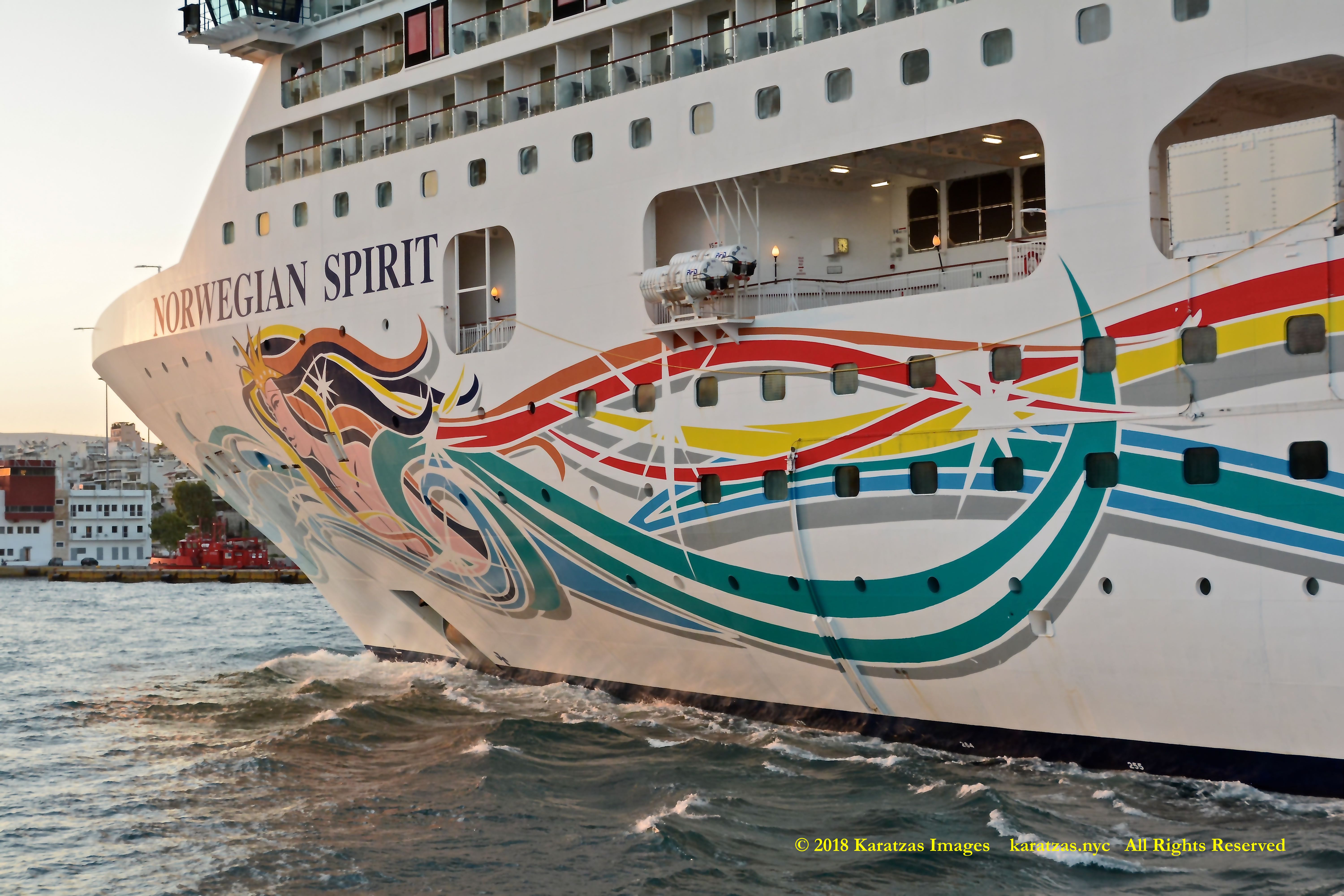
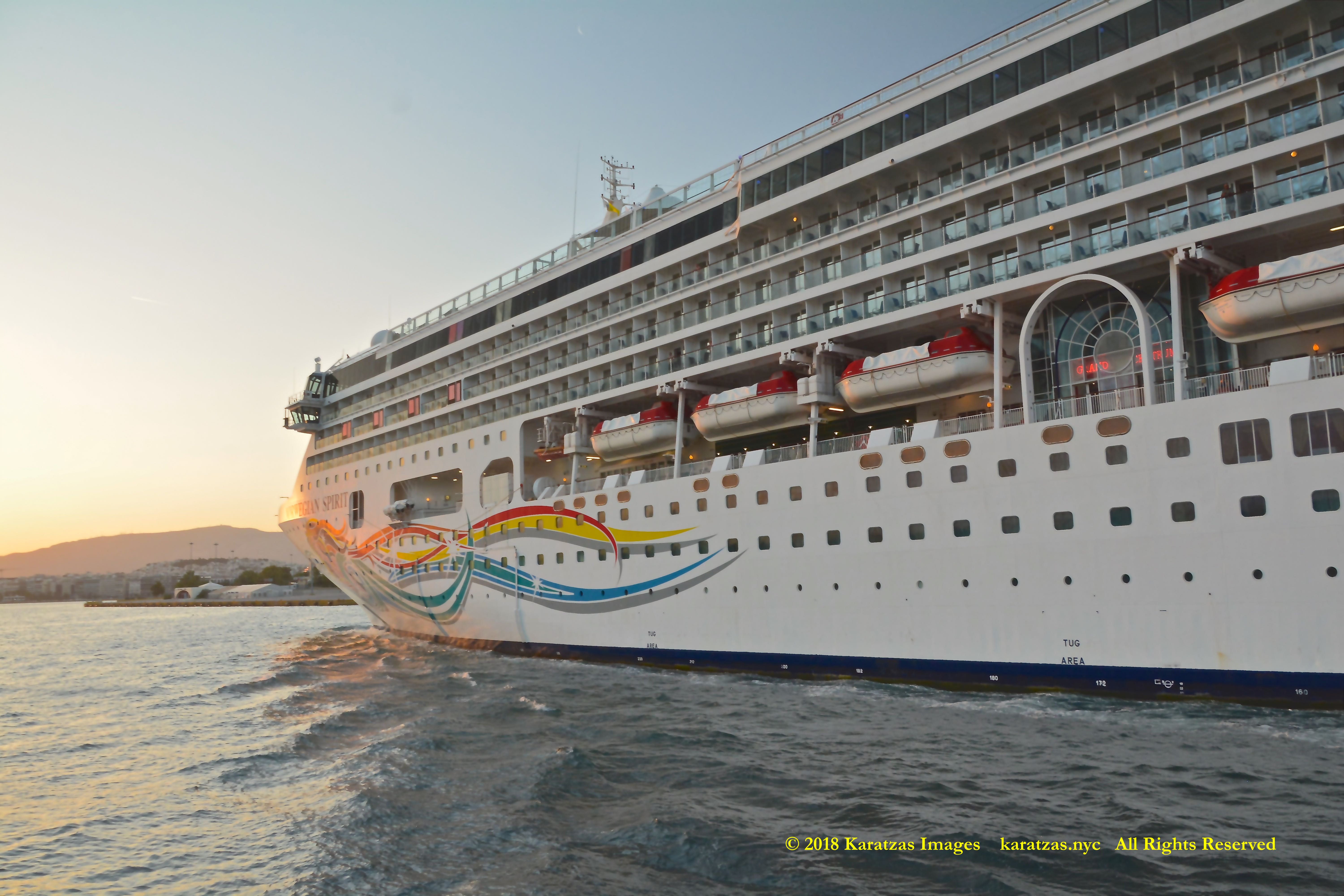
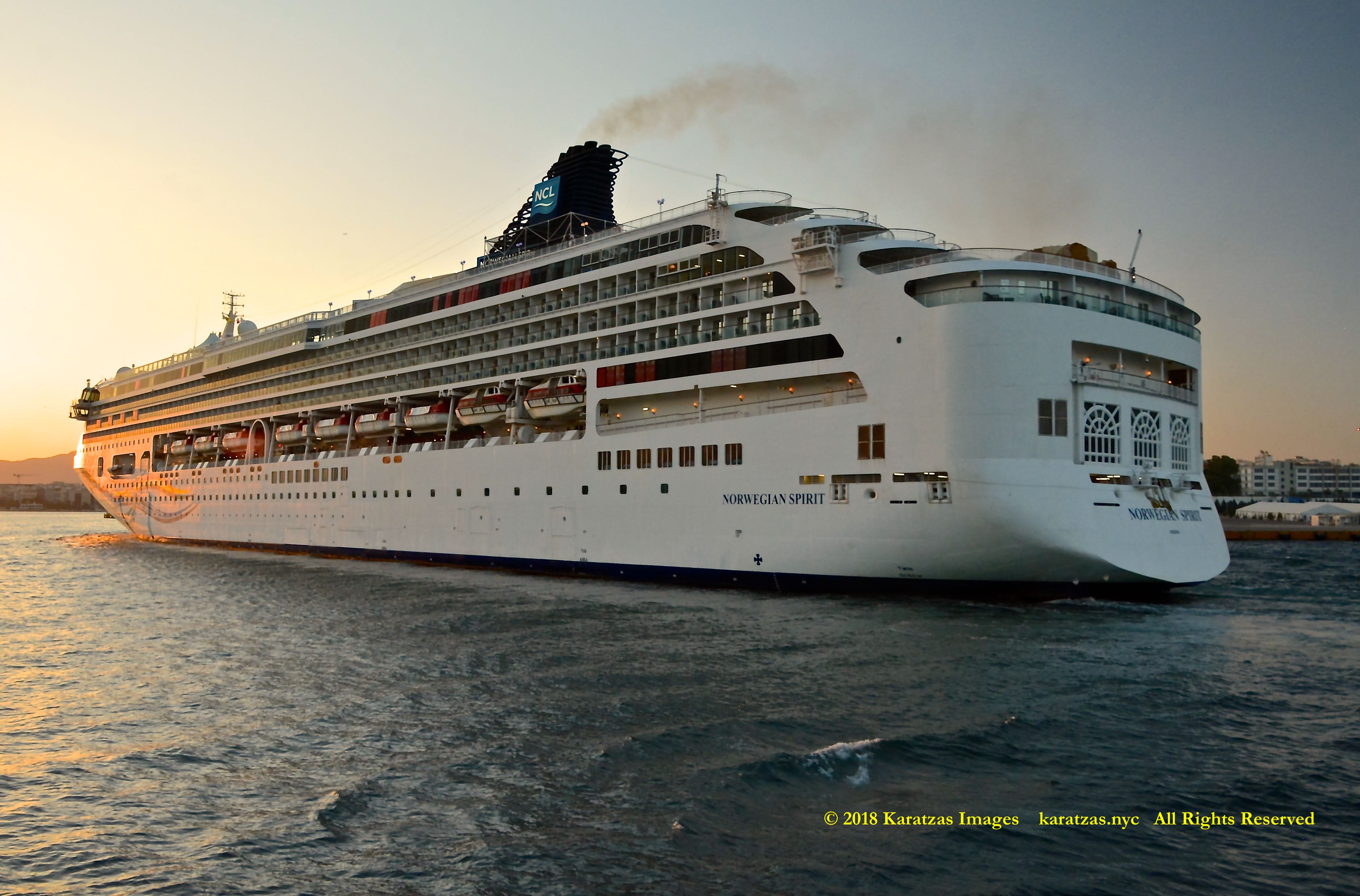
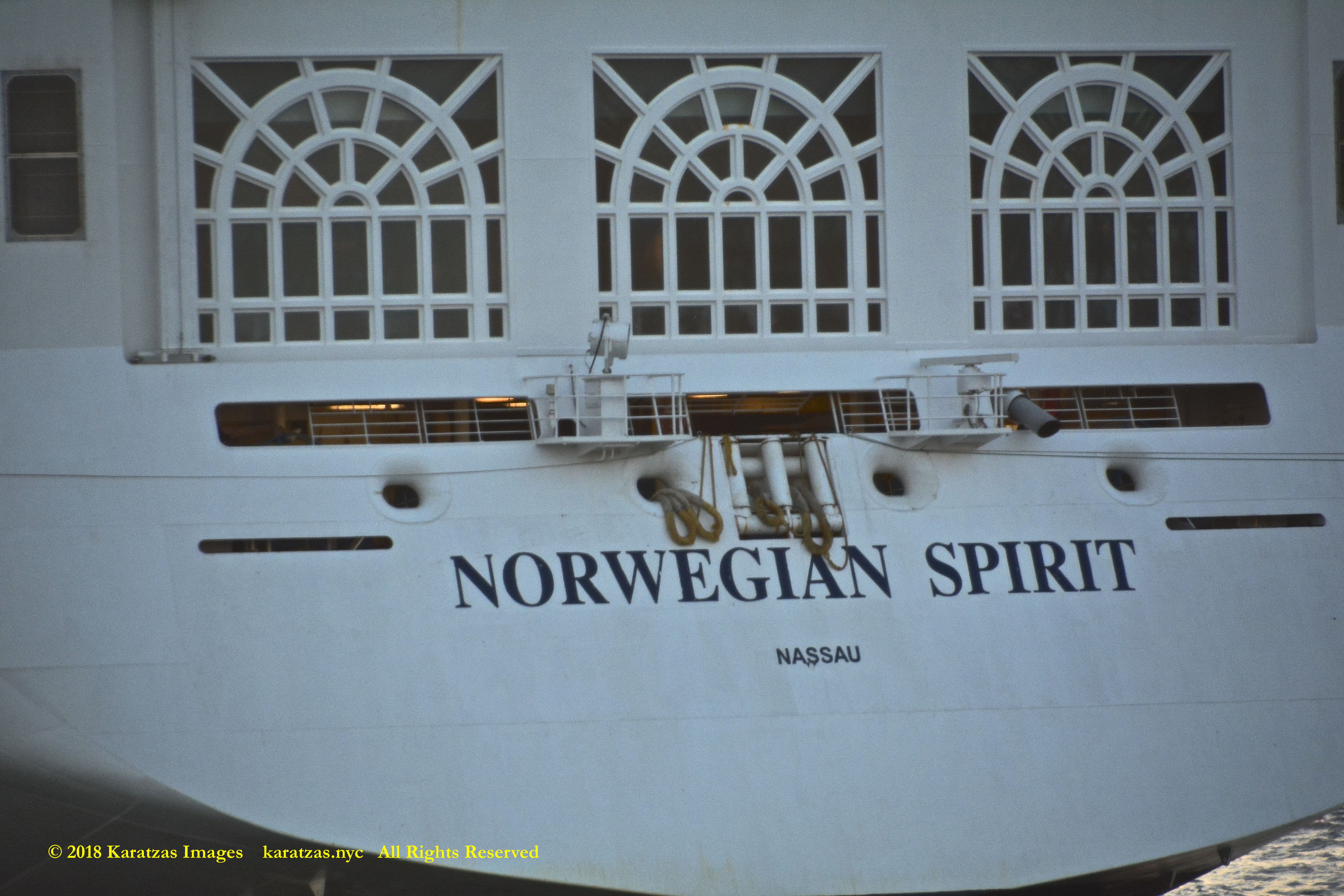
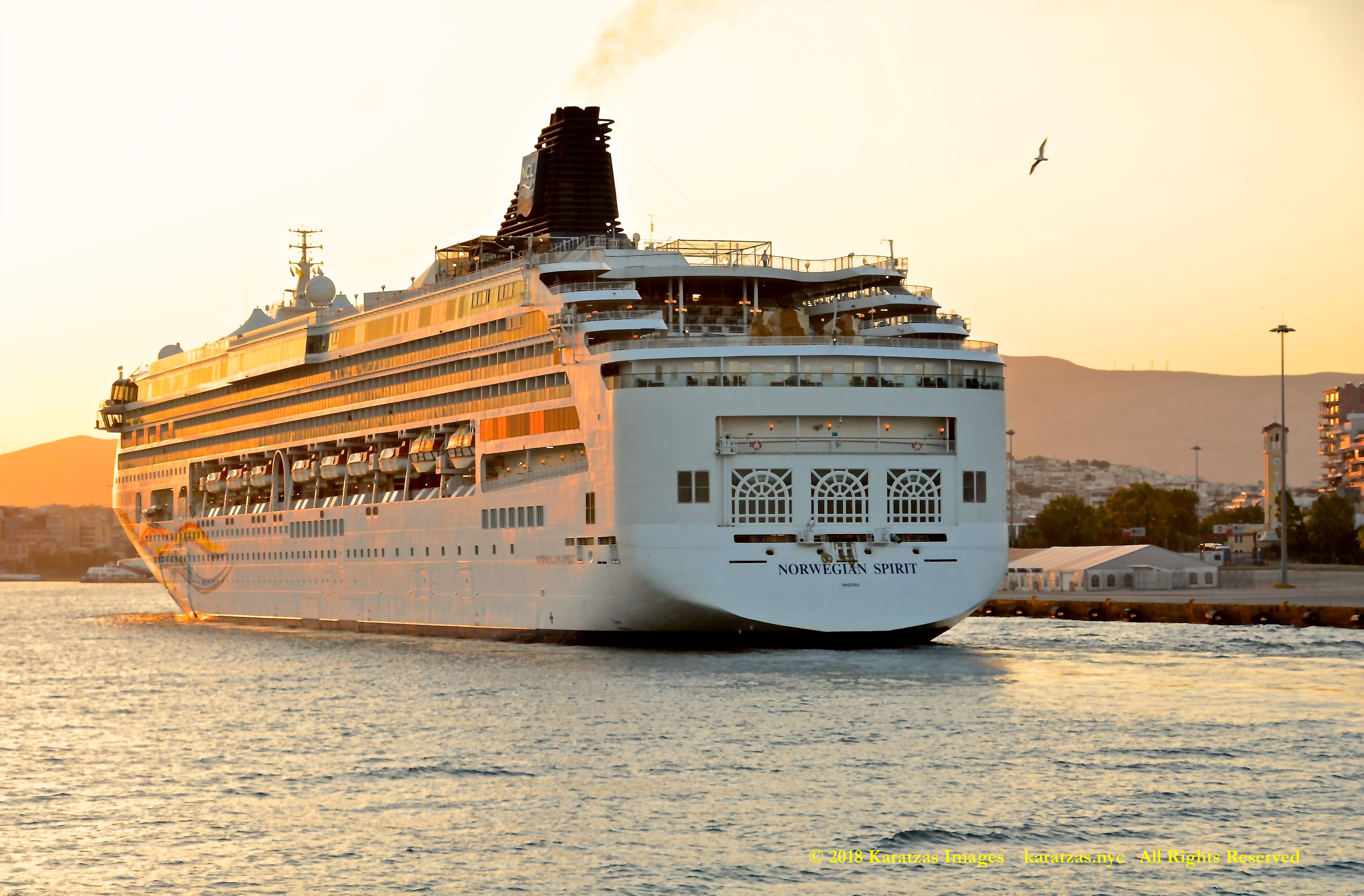
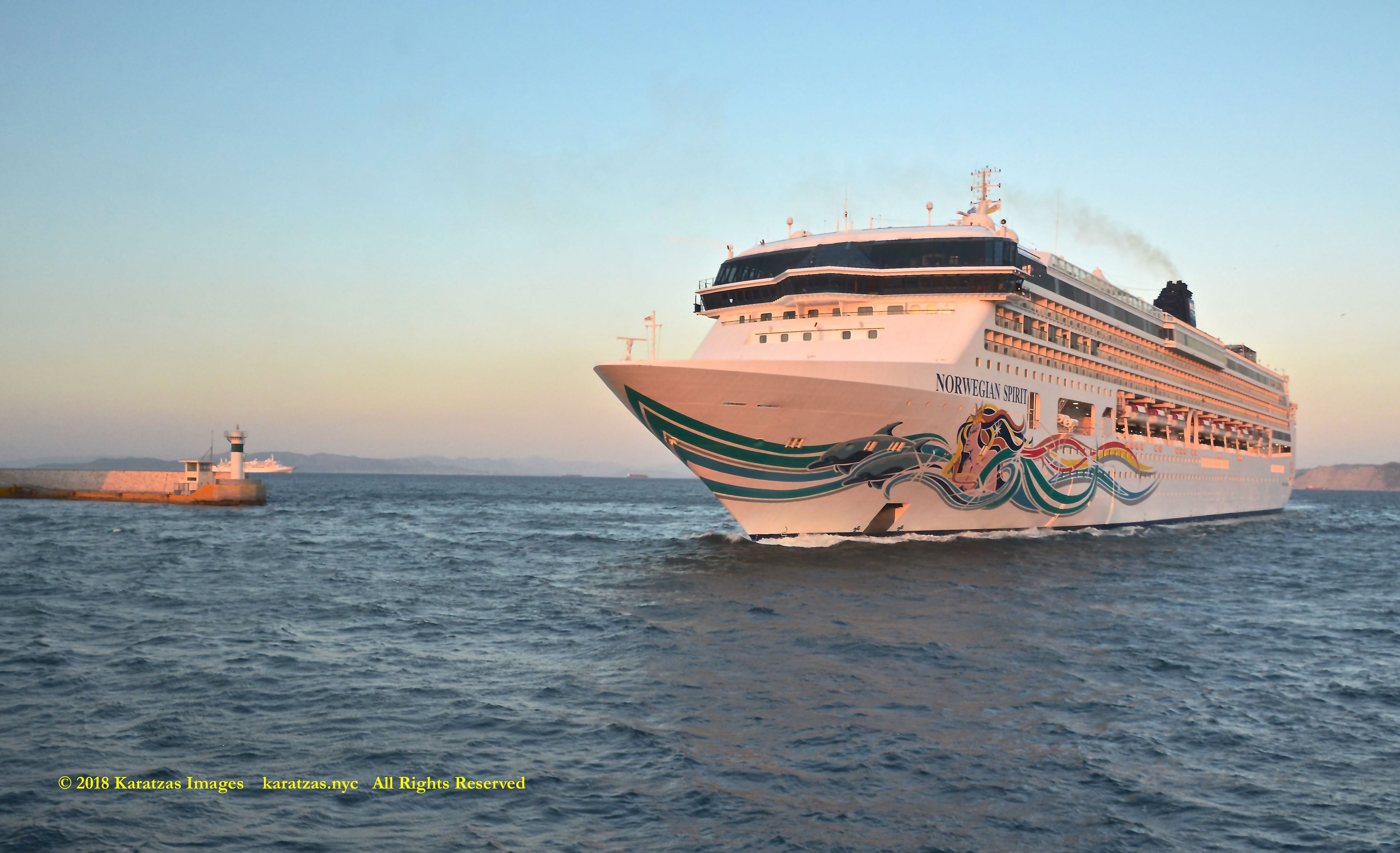
Images of Cruiseship MV ‘Norwegian Spirit’ in Piraeus, Greece

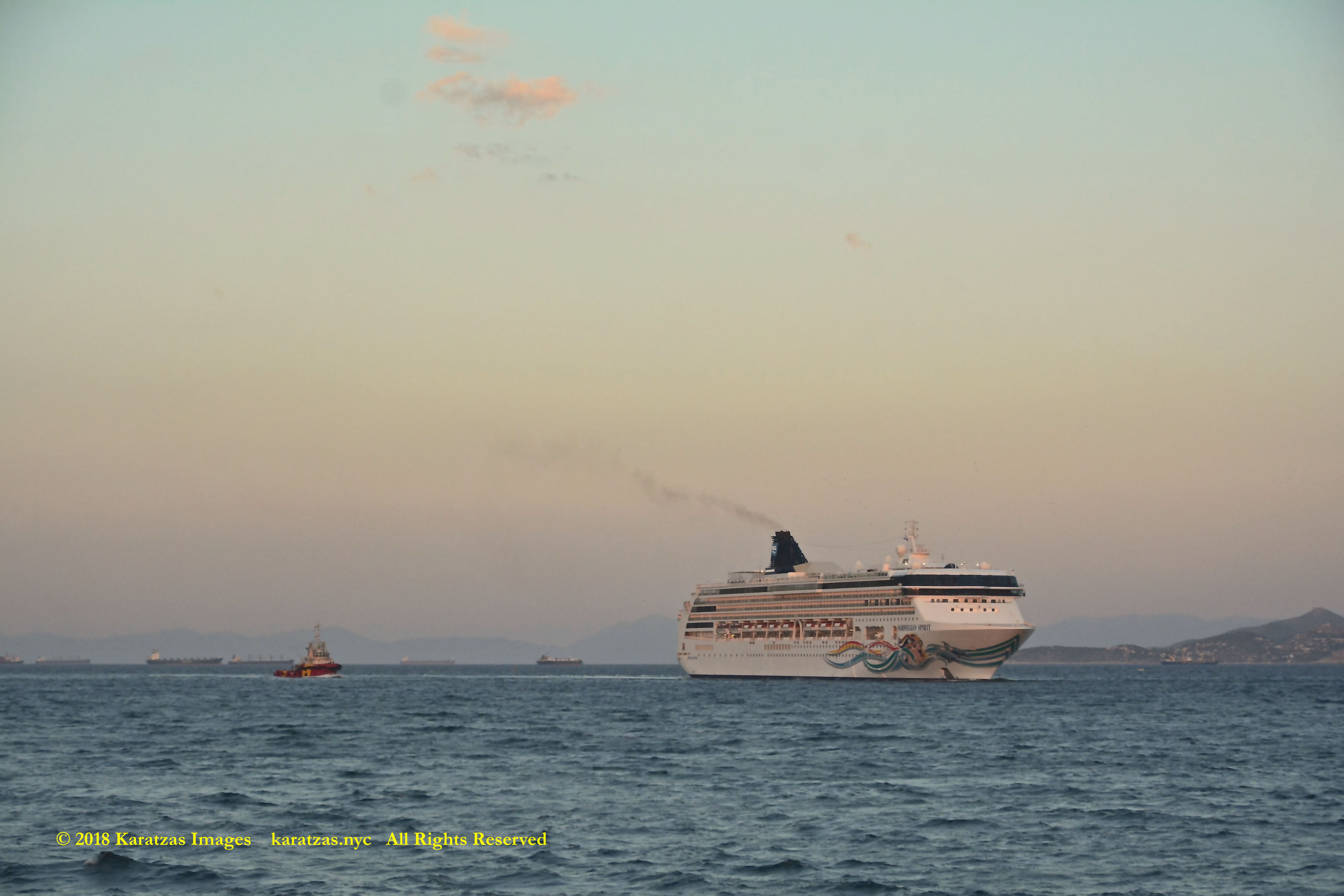
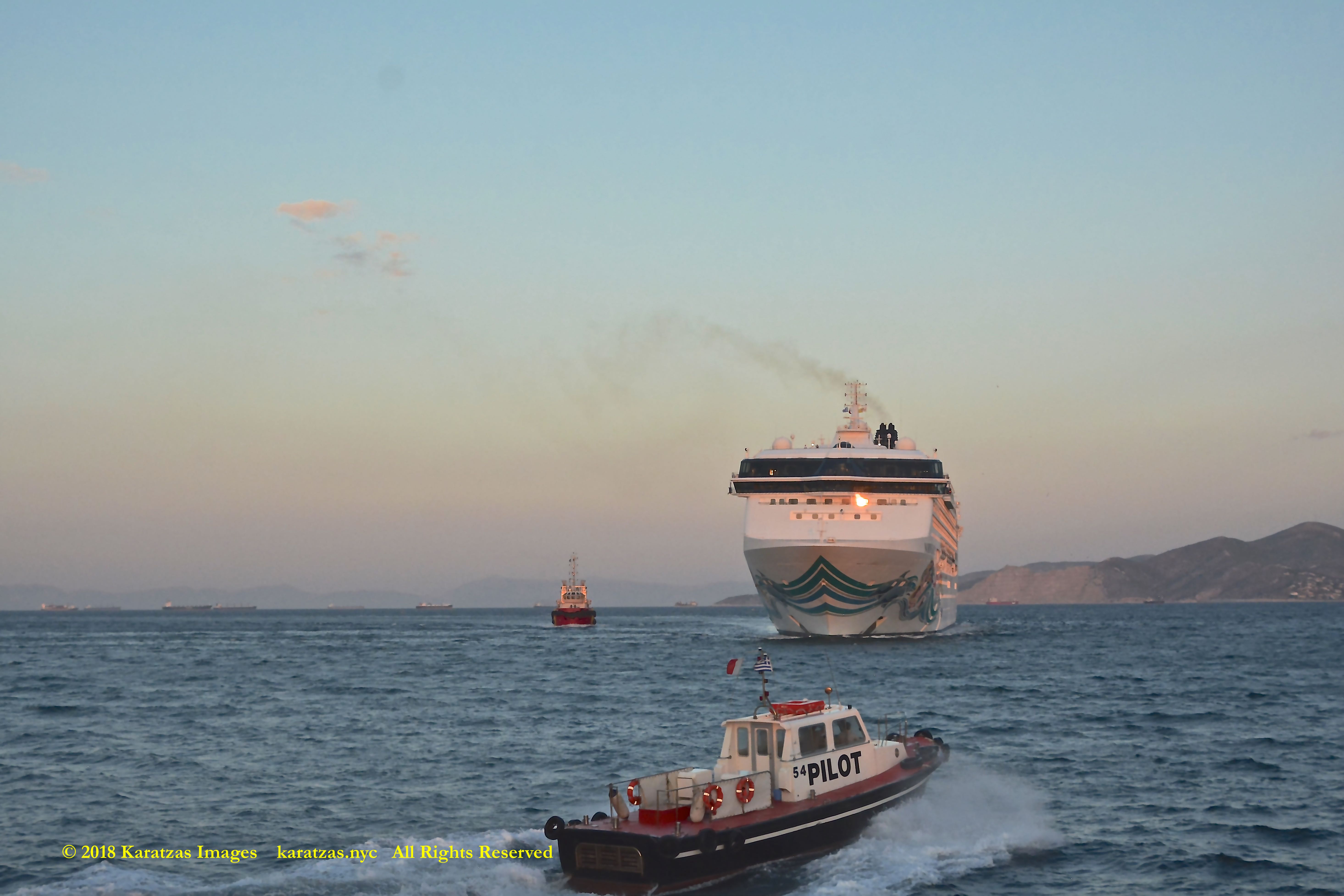
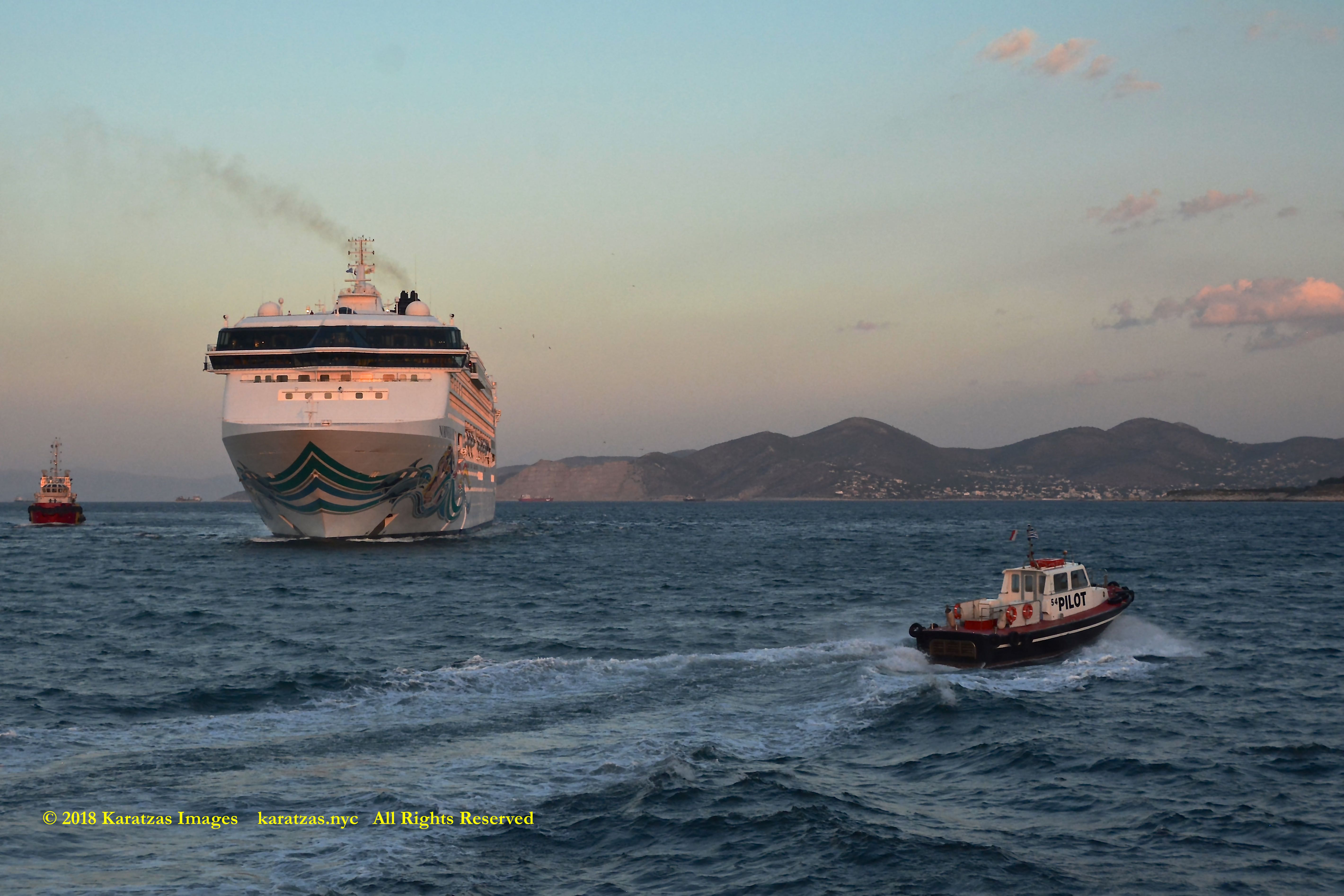
MV ‘Norwegian Spirit’ Entering the Port of Piraeus
Cruiseship of 2,018 Berths, built in 1998 at Meyer Werft, Germany

VESSEL IDENTIFICATION & DESCRIPTION: Call Sign C6TQ6, IMO Number 9141065. Ordered in 1995 and built at Meyer Werft shipyard in Papenburg, Germany, delivered in Jun 1998, Bahamas Flagged, DNV Classed, P&I insurance with Steamship Mutual P&I, Length Overall of 268.60 m., Length Between Perpendiculars of 235.60 m., Draught of 8.40 m., Moulded Depth of 11.50 m., Beam of 32.20 m., Gross Tonnage of 75,338, Tonnage of 45,235 International Net and 8,395 Dwt (long).

The vessel was constructed by Meyer Werft in Germany in 1998 for account of Star Cruises, the Malaysia-based subsidiary of the Genting Group. Her Launch Name was MV ‘SuperStar Leo’ and she was the first vessel of Star Cruises’ Leo-class. Vessel originally home-ported in Singapore and operated for Star Cruises to Malaysia and Thailand. In 2000, Star Cruises acquired Norwegian Caribbean Line; In 2007, Star Cruises sold 50% of Norwegian for $1 billion to US-based Apollo Management (owners of Oceania Cruises).

In 2004, Norwegian Cruise Line was planning to launch the cruiseship MV ‘Pride of America’. However, just prior to completion, the vessel partially sank when a storm hit the Lloyd Werft shipyards. To meet the already booked cruises for MV ‘Pride of America’, the cruiseship MV ‘Norwegian Sky’ was immediately rushed into service under the name MV ‘Pride of Aloha’. To compensate for the unexpected events, cruiseship MV ‘SuperStar Leo’ was immediately transferred to the NCL fleet, her planned cruises cancelled, and after only two weeks of refits, the vessel emerged as the cruiseship MV ‘Norwegian Spirit’, ready to assume the planned cruises of MV ‘Norwegian Sky’.

There is only one sistership vessel built under the ‘Leo Class’ (now ’Spirit Class’ with NCL), the cruiseship MV ’SuperStar Virgo’ which is owned by Star Cruises. Since the ‘Leo Class’ vessels were designed for the Asian market, this cruiseship is generally on a shorter scale in height than most cruise ships. This also means shorter deck chairs for lounging, hand rails in the corridors and so on.

VESSEL’S OWNERS / MANAGERS: Norwegian Cruise Line (NCL), United States. [Norwegian is a publicly traded company listed on the New York Stock Exchange, with major shareholders including Apollo Global Management (15.8%), Genting Group (11.1%), and TPG Capital (2.3%). Norwegian Cruise Line controls approximately 8% of the total worldwide share of the cruise market.]

PASSENGER CAPACITY: Total number of Passengers 2,300, 983 Passenger Cabins, 2018 Passenger Berths, 959 Crew. 14 decks.

MAIN ENGINE: 4 x Diesel Gen – MAN Energy Solutions 14V48/60 – 4-stroke 14-cyl. 480mm x 600mm bore/stroke 58,796mkW total at 514rpm driving 4 x AC generator(s) at 60Hz.

PROPULSOR: 2 x Azimuth (Aft) (electric) AC.

NEWBUILDING COST: Reported newbuilding price of US$ 350 million, contracted in 1995.


Images of Norwegian Cruise Line cruiseships posted previously on our blog, mostly from their port calls to New York Cruise Terminal and in Piraeus can be accessed by clicking on following link!


Cruiseship MV ‘Norwegian Spirit’ entering the Port of Piraeus, Greece. Image credit: Karatzas Images

Cruiseship MV ‘Norwegian Spirit’ entering the Port of Piraeus, Greece. A pilot boat outbound. Image credit: Karatzas Images

Cruiseship MV ‘Norwegian Spirit’ entering the Port of Piraeus, Greece. Image credit: Karatzas Images

Cruiseship MV ‘Norwegian Spirit’ entering the Port of Piraeus, Greece. Image credit: Karatzas Images

Cruiseship MV ‘Norwegian Spirit’ entering the Port of Piraeus, Greece. Image credit: Karatzas Images

Cruiseship MV ‘Norwegian Spirit’ entering the Port of Piraeus, Greece. Image credit: Karatzas Images

Cruiseship MV ‘Norwegian Spirit’ entering the Port of Piraeus, Greece. Image credit: Karatzas Images

Cruiseship MV ‘Norwegian Spirit’ entering the Port of Piraeus, Greece. Image credit: Karatzas Images

Cruiseship MV ‘Norwegian Spirit’ entering the Port of Piraeus, Greece. Image credit: Karatzas Images

Cruiseship MV ‘Norwegian Spirit’ entering the Port of Piraeus, Greece. Image credit: Karatzas Images

Cruiseship MV ‘Norwegian Spirit’ entering the Port of Piraeus, Greece. Image credit: Karatzas Images

Cruiseship MV ‘Norwegian Spirit’ entering the Port of Piraeus, Greece. Image credit: Karatzas Images

Cruiseship MV ‘Norwegian Spirit’ entering the Port of Piraeus, Greece. Image credit: Karatzas Images

© 2013 – present Basil M Karatzas & Karatzas Marine Advisors & Co.  All Rights Reserved.

IMPORTANT DISCLAIMERS:  Vessel description is provided in good faith and is believed to be correct and accurate but no assurances, warranties or representations are made herewith. Vessel description is provided for entertainment  purposes only. We have no responsibility whatsoever for any errors / omissions in vessel description.
Access to this blog signifies the reader’s irrevocable acceptance of this disclaimer. No part of this blog can be reproduced by any means and under any circumstances, whatsoever, in whole or in part, without proper attribution or the consent of the copyright and trademark holders of this website. Whilst every effort has been made to ensure that information herewithin has been received from sources believed to be reliable and such information is believed to be accurate at the time of publishing, no warranties or assurances whatsoever are made in reference to accuracy or completeness of said information, and no liability whatsoever will be accepted for taking or failing to take any action upon any information contained in any part of this website.  Thank you for the consideration.